

Most founders build their first financial model when someone asks for it. An investor requests projections. A bank wants to see forecasts before approving a loan. An accelerator asks for a one-year plan. The model gets built under time pressure, with one audience in mind, and then sits in a folder until the next external request arrives.
For a bootstrapped startup, that approach is genuinely dangerous. When your business runs on revenue rather than investor capital, the financial model is not a pitch document. It is the instrument panel of the aircraft you are flying. If it is wrong, outdated, or built for someone else’s purposes, you are navigating without reliable information, and in a business with no safety net that is how founders run out of cash while believing they have months of runway left.
Startup booted financial modeling is the practice of building, maintaining, and making decisions from a financial model designed specifically for the constraints of a self-funded business. It is different from the models built for investor presentations in almost every dimension: its purpose, its assumptions, its level of detail, and the frequency with which it is updated. Understanding those differences is not an academic exercise. It determines whether a bootstrapped founder can see problems coming early enough to respond or discovers them when the options have already run out.
This guide covers what a booted financial model actually needs to contain, how to build each component correctly with real formulas and real numbers, how to use the model as a decision-making tool rather than a reporting exercise, and the specific mistakes that consistently cause founders to misread their own financial position. The goal is a model that is honest, lean, and genuinely useful in the way that matters most: keeping the business alive long enough to build something worth keeping.
Contents
- 1 What Makes Startup Booted Financial Modeling Fundamentally Different
- 2 Layer One: Building a Revenue Model That Is Actually True
- 3 Layer Two: The Cash Flow Model and Why It Overrides Everything Else
- 4 Layer Three: Break-Even Analysis as a Decision-Making Framework
- 5 Layer Four: Runway Calculation and What It Is Actually Telling You
- 6 Layer Five: Scenario Planning for the Business That Has Not Happened Yet
- 7 Unit Economics: The Foundation That Makes Everything Else Make Sense
- 8 Booted Financial Model vs VC-Backed Financial Model: A Practical Comparison
- 9 Mistakes That Make Bootstrapped Financial Models Dangerously Wrong
- 10 How to Use the Model as an Operating Tool Rather Than a Reporting Document
- 11 Frequently Asked Questions
- 12 Conclusion
What Makes Startup Booted Financial Modeling Fundamentally Different
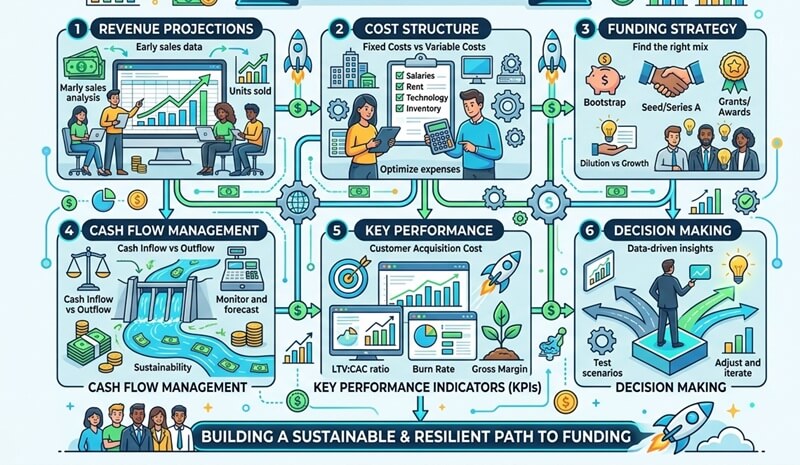
The difference between a booted financial model and a venture-backed financial model is not a question of sophistication. In many ways the booted model requires more discipline because it cannot rely on the assumption that additional capital will arrive to correct mistakes. Every number in the model has direct operational consequences that land within weeks or months rather than being deferred by a fundraising round.
A VC-backed startup’s financial model is primarily a communication tool. It is built to tell a coherent story about a large addressable market, a plausible path to significant revenue, and a return profile that justifies the investor’s capital allocation. The model does not need to be right about the near-term numbers. It needs to be credible about the long-term direction. Aggressive growth assumptions are a feature rather than a bug because they make the investment case compelling.
A booted startup’s financial model has no such license. Every revenue assumption needs to be grounded in something that has already happened or is demonstrably underway. Every cost needs to be accounted for with the specificity of someone who knows there is no rescue capital coming. The model needs to answer a different set of questions: Can we pay our bills next month? When do we reach the point where revenue reliably covers expenses? What happens to the business if revenue comes in 30 percent below our base case? Those are survival questions, not pitch questions, and they require a model built for survival.
The practical consequence of this difference is that a booted financial model tends to be simpler in structure but harder in honesty. You do not need fifteen tabs tracking every conceivable business metric. You need four or five tightly connected sheets that reflect the actual mechanics of your specific business, updated with real numbers every month, and reviewed with genuine attention to what the data is telling you.
Layer One: Building a Revenue Model That Is Actually True
The revenue model is where most bootstrapped founders make their first and most consequential mistake. They forecast revenue by asking what they need to reach a goal rather than asking what the evidence suggests will actually happen. The two starting points produce numbers that look similar in a spreadsheet and diverge dramatically in the real world.
A revenue-first model starts from the smallest defensible unit: the individual customer or transaction. For a SaaS business, that unit is the monthly or annual subscription. For a services business, it is the retainer or project. For a product business, it is the unit sale. Once you have that unit, you build the model by forecasting how many units you will add each period and how many you will lose.
The Mechanics of Revenue Forecasting
Monthly recurring revenue for a subscription business follows a simple formula: the revenue in any given month equals the revenue from the prior month, plus the revenue from new customers acquired that month, minus the revenue lost from customers who cancelled. Written out, that is: MRR this month equals MRR last month plus new MRR minus churned MRR.
The discipline is in the assumptions behind the new MRR and churned MRR figures. New MRR should be derived from a conversion model, not a wish. If your current process generates approximately 50 qualified leads per month and your close rate is 10 percent, then you can project five new customers per month with reasonable confidence. Forecasting 20 new customers per month because you plan to improve your close rate is not a revenue forecast. It is a goal dressed up as a number.
Churn is the metric that most bootstrapped founders underestimate most consistently. A monthly churn rate of 3 percent sounds small. Compounded over 12 months, a business starting with 100 customers will lose approximately 30 of them by year-end before counting any new additions. At 5 percent monthly churn, you lose nearly half your starting base in a year. The revenue model needs to reflect this honestly because the business decisions that follow from a model showing steady revenue growth look very different from the decisions that follow from a model showing the same starting revenue but high churn eroding it from underneath.
Customer Lifetime Value and Why It Must Inform Every Revenue Decision
Customer lifetime value is the total revenue a single customer generates across their entire relationship with the business. For a subscription business, a simple calculation is: average monthly revenue per customer divided by monthly churn rate. If a customer pays 100 dollars per month and your monthly churn rate is 4 percent, the average customer lifetime value is 2,500 dollars.
This number matters enormously for a bootstrapped business because it defines the ceiling on how much you can rationally spend to acquire a customer. The widely cited benchmark is that customer acquisition cost should not exceed one-third of lifetime value. For the business above, that means spending no more than approximately 833 dollars to acquire each customer. If your current acquisition cost exceeds that figure, you are destroying value with every sale, and scaling the business will accelerate the destruction rather than fix it. No revenue forecast makes a broken unit economics model sustainable.
Layer Two: The Cash Flow Model and Why It Overrides Everything Else
Revenue is not cash. This is the single most dangerous misunderstanding in early-stage financial planning. Revenue is the value of goods or services delivered, recognised according to accounting rules. Cash is the money in your bank account that you can use to pay your rent, your salaries, and your software subscriptions. For a bootstrapped startup, cash is the only metric that determines whether the business is alive next month.
Profitable businesses die from cash flow problems. This happens in bootstrapped companies when customers pay on 60-day terms but suppliers require payment in 30 days, when a large annual contract is recognised as revenue over 12 months but the customer paid upfront and the recognition rules make it look like future revenue, or when a founder reinvests all cash into inventory or development without modelling the timing of when that investment converts back into receivable cash.
Building the Cash Flow Forecast Correctly
A cash flow forecast for a bootstrapped startup should track three categories with precision. Cash in covers all actual receipts: customer payments on the date they are received, not the date they are invoiced. This distinction is critical for businesses that invoice on terms. A 10,000 dollar invoice sent in January is not January cash if your customer pays in March.
Cash out covers all actual disbursements: salaries and contractor payments on payroll dates, software and tool subscriptions on billing dates, rent on the due date, and any irregular payments like insurance premiums, tax instalments, or equipment purchases. The level of detail here should reflect the actual predictability of the expense. A monthly subscription that bills on the 15th should appear on the 15th in your model.
The ending cash balance for each month equals the prior month ending balance plus cash in minus cash out. This is the number that matters. It tells you on what date the business runs out of cash if current trends continue unchanged. That date is what the entire model is designed to keep pushing forward, either by increasing cash in or by reducing cash out or by adding a capital buffer before the balance approaches zero.
The Minimum Cash Buffer and Why It Must Be Non-Negotiable
Every bootstrapped startup needs a defined minimum cash buffer: a floor below which the bank balance must not drop, regardless of what opportunities or pressures emerge. The appropriate buffer depends on the predictability of revenue and the fixed cost base. A business with highly predictable monthly recurring revenue and low fixed costs can operate on two months of fixed costs as a minimum buffer. A business with lumpy project revenue and a larger fixed cost base needs four to six months.
This buffer is not an emergency fund. It is a decision threshold. When your cash balance approaches the minimum buffer, the model is telling you that a decision is required: cut costs, accelerate collections, defer a hire, or begin a capital raise. Having that threshold defined in advance means you see the trigger coming with enough lead time to act on it rather than discovering you are below the buffer when the options have narrowed.
Layer Three: Break-Even Analysis as a Decision-Making Framework
Break-even is the point at which total revenue equals total costs. For a bootstrapped startup, reaching break-even is not merely a financial milestone. It is the moment at which the business stops requiring the founder’s personal resources or existing cash reserves to survive and begins sustaining itself from its own operations. Everything before break-even is borrowed time. Everything after it is genuine ground.
The Break-Even Formula and How to Apply It
The break-even calculation requires two inputs: your fixed costs per month and your contribution margin per unit of revenue. Fixed costs are the expenses that remain constant regardless of how much revenue you generate: rent, base salaries, essential software, insurance, and any other recurring obligations. Variable costs are the expenses that scale directly with revenue: payment processing fees, customer support time per customer, hosting costs that scale with usage, or physical materials for product businesses.
The contribution margin per customer is the revenue from that customer minus the variable costs attributable to serving them. For a SaaS business charging 100 dollars per month with three dollars in payment processing fees and two dollars in infrastructure costs per customer, the contribution margin is 95 dollars. The break-even customer count is total monthly fixed costs divided by contribution margin per customer. If your fixed costs are 20,000 dollars per month and your contribution margin is 95 dollars, you need approximately 211 customers to break even.
That number becomes the most important target in the entire model. It tells you specifically how far away sustainability is. It tells you what happens to that distance if you add a hire that increases fixed costs. It tells you whether a pricing experiment that reduces contribution margin moves break-even dangerously far out. Every significant business decision in the bootstrapped phase should be evaluated against its effect on the break-even calculation before it is made.
Break-Even as a Hiring Trigger
The break-even framework provides the most disciplined answer available to the question every bootstrapped founder faces: when can I afford to hire? The answer is when projected revenue, accounting for reasonable churn, will cover the new hire’s total cost including salary, benefits, and any tools or workspace requirements for a minimum of three consecutive months before the hire starts. Three months is the minimum. Six months is better. A hire that brings fixed costs above break-even before revenue has grown to absorb them is a hire that shrinks the runway and increases the urgency of the next capital decision.
Layer Four: Runway Calculation and What It Is Actually Telling You
Runway is the number of months the business can continue operating before it runs out of cash, assuming current revenue and expense patterns continue unchanged. It is the metric that translates everything else in the model into a single urgency number. A business with 12 months of runway has time to adjust, to experiment, to let certain bets play out. A business with three months of runway is in crisis whether or not the founder recognises it as such.
Calculating Runway Correctly
The basic runway formula divides current cash balance by monthly net burn. Net burn is the difference between total cash out and total cash in per month. If you have 120,000 dollars in the bank and your net burn is 15,000 dollars per month, you have eight months of runway.
The complication is that most businesses do not have flat burn. Revenue is typically growing, which means the net burn is shrinking over time, or declining, which means the net burn is expanding. A static runway calculation using current month numbers is only accurate for businesses with perfectly flat revenue and costs, which describes almost no real business. The more accurate approach is to run the full cash flow forecast and identify the specific month in which the ending balance drops to or below the minimum cash buffer. That month, minus today, is the real runway.
This distinction matters enormously in practice. A founder looking at a static burn calculation might see eight months of runway and feel comfortable. The same founder running a full cash flow model might discover that a combination of expected cost increases and a realistic revenue growth curve produces a cash balance that drops below the minimum buffer in month five. That is a three-month difference in the decision timeline, which is the difference between beginning a capital raise from a position of calm and beginning one from a position of desperation.
The Revenue Growth Rate’s Effect on Runway
The most powerful lever on runway for a growing bootstrapped startup is the revenue growth rate. A business burning 15,000 dollars per month with flat revenue has a finite runway that counts down each month. The same business with 10 percent monthly revenue growth has an improving burn profile: each month the net burn shrinks as revenue covers more of the fixed cost base. At 10 percent monthly revenue growth from a starting MRR of 8,000 dollars, the business reaches break-even in approximately six months without any cost reduction. At 5 percent monthly growth from the same starting point, break-even takes closer to 14 months.
This makes the revenue growth rate not just a vanity metric but a survival input. Understanding the relationship between your current growth rate and your current burn rate gives you the answer to the most important question in early-stage bootstrapped finance: are we going to make it before the cash runs out?
Layer Five: Scenario Planning for the Business That Has Not Happened Yet
The purpose of a financial model is not to predict the future. That is not possible. The purpose is to understand the financial consequences of different futures so that decisions made today are informed by a realistic range of outcomes rather than a single optimistic projection.
Most founders who build financial models build one scenario: the one where things go reasonably well. Revenue grows at the expected rate, costs stay roughly in line with the plan, and the business reaches break-even on the timeline the model shows. This is the base case. It is worth having. But it is the least useful scenario for a bootstrapped founder because it is the one that requires the least preparation.
Building the Downside Case First
The scenario that deserves the most attention in a booted financial model is the downside case: the version of the future where revenue comes in 25 to 35 percent below the base case projections. This is not pessimism. It is the appropriate frame for a business without a capital cushion. The downside case should ask: what does the cash flow model look like if we acquire half the customers we project, if churn runs 50 percent higher than our base case, and if one of our top three customers churns in the next quarter?
The downside case tells you whether the business survives a bad quarter without requiring emergency action. If the downside case produces a cash balance that approaches the minimum buffer within three months, the business is operating with insufficient margin for error and the model is telling you to either reduce the cost base, accelerate a capital raise, or identify a specific revenue lever that can be pulled quickly if the downside scenario begins to materialise.
The Upside Case and Its Specific Value
The upside case, where revenue grows faster than the base projection, has a different purpose. It is not primarily a reason to feel confident. It is a planning tool for resource allocation. If revenue grows at double the base case rate, what constraints will bind first: hiring capacity, infrastructure, customer support bandwidth, or the founder’s own time? The upside case identifies bottlenecks before they become crises and allows the business to build those capacities ahead of the demand rather than scrambling to catch up.
How Often to Update the Model
A booted financial model should be updated with actual numbers monthly, at minimum. The discipline of comparing actual results to the prior month’s projections reveals systematic errors in the model’s assumptions, which can then be corrected before they compound. A model that has not been updated with actuals for three months is not a financial model. It is a historical document with no navigational value.
For businesses with cash balances that are tightening toward the minimum buffer, weekly cash flow tracking replaces monthly updating as the primary monitoring cadence. At that level of urgency, monthly review cycles are too slow to identify problems in time to act on them.
Unit Economics: The Foundation That Makes Everything Else Make Sense
Unit economics is the financial analysis of a single unit of business: one customer, one transaction, one subscription. If the unit economics are positive, meaning each customer generates more value than they cost to acquire and serve, then growth makes the business stronger. If the unit economics are negative, then growth makes the business weaker, and the model is a countdown to a crisis rather than a roadmap to sustainability.
The three unit economics metrics that matter most for a bootstrapped startup are customer acquisition cost, customer lifetime value, and the payback period. Customer acquisition cost is the total amount spent on sales and marketing in a given period divided by the number of new customers acquired in that period. If you spent 10,000 dollars on marketing last month and acquired 20 new customers, your customer acquisition cost is 500 dollars.
Customer lifetime value, as discussed earlier, is the total revenue a customer generates over their relationship with the business. The ratio of lifetime value to customer acquisition cost is the central diagnostic of business health. A ratio below 1 means you are spending more to acquire customers than they will ever generate in revenue. A ratio between 1 and 3 means the business is sustainable but not efficiently so. A ratio above 3 means the unit economics support growth investment and the primary constraint is likely customer acquisition capacity rather than economics.
The payback period is how long it takes for a customer’s cumulative revenue to equal the cost of acquiring them. If your customer acquisition cost is 500 dollars and your monthly contribution margin per customer is 50 dollars, the payback period is 10 months. For a bootstrapped startup with limited cash, a 10-month payback period means every new customer requires the business to carry the acquisition cost for nearly a year before breaking even on that customer alone. This has direct implications for cash flow and runway that the model must account for explicitly.
Booted Financial Model vs VC-Backed Financial Model: A Practical Comparison
The table below summarises the key differences between a model built for bootstrapped survival and one built for investor communication. Understanding these differences helps founders avoid the common mistake of building the wrong kind of model for their actual situation.
| Modeling Dimension | Booted Financial Model | VC-Backed Financial Model |
| Primary Purpose | Survival, cash visibility, decision-making | Investor persuasion, growth narrative |
| Revenue Assumptions | Conservative, validated by real customers | Aggressive, based on market size capture |
| Forecast Horizon | 12 months rolling, updated monthly | 3 to 5 year projections, updated quarterly |
| Cash Focus | Days of cash on hand, weekly monitoring | Quarterly burn rate and runway |
| Break-even Priority | Central goal and decision trigger | Deprioritised in favour of growth speed |
| Headcount Modelling | Added only when revenue covers cost for 3 months | Added based on hiring plan and VC milestones |
| Scenario Planning | Downside-first, then base and upside cases | Upside-first, downside rarely modelled |
| Unit Economics | Non-negotiable from day one | Often deferred until Series B or C |
| Model Complexity | Simple, one tab, updated by founder | Multi-tab, often built by CFO or advisor |
| Failure Signal | Cash balance approaching minimum buffer | Inability to raise next round |
Mistakes That Make Bootstrapped Financial Models Dangerously Wrong
The mistakes that cause bootstrapped founders to misread their own financial position are consistent enough across companies and founders that they deserve specific attention. None of them are the result of dishonesty. Most are the result of optimism, unfamiliarity with the mechanics of the model, or a failure to separate the model’s purpose from the pitch deck’s purpose.
The most damaging mistake is confusing revenue recognition with cash receipt. A SaaS startup that charges annually upfront receives 12 months of cash in month one but recognises that revenue evenly across 12 months. If the founder models this as monthly recurring revenue arriving evenly each month, the cash flow model shows a false picture of the bank balance declining steadily through the year. The actual bank balance peaked in month one and declines faster than the revenue recognition model suggests. The cash flow model must track actual receipts, not recognised revenue.
The second consistent mistake is leaving founder compensation out of the model or dramatically underestimating it. A founder who is not paying themselves a salary is not building a business without a compensation cost. They are subsidising the business from their personal savings or their prior career savings. The model should include a realistic founder salary from the moment the business could rationally support one, because a business whose financial model only works if the founder works for free is not economically viable on any credible timeline.
The third mistake is modelling revenue with a single growth rate applied uniformly across all periods. Real businesses do not grow at a uniform monthly rate. They grow in response to specific actions: a new marketing channel that takes three months to build, a product improvement that drives referral growth, a partnership that unlocks a new customer segment. The model should be driven by specific customer acquisition activities and their expected outputs, not by a single percentage applied to the prior month’s number.
The fourth mistake is building the model once and never updating it. A financial model updated annually with targets is a budget. A financial model updated monthly with actuals against projections is a navigation instrument. The difference in usefulness is the difference between knowing where you planned to be and knowing where you actually are.
The fifth mistake is omitting irregular but predictable costs. Annual software renewals, quarterly tax payments, insurance premiums, and equipment replacement all fall outside the monthly recurring pattern but are entirely predictable. A model that only captures monthly recurring expenses understates the true cash out in the months those irregular costs land and produces an overly optimistic runway calculation as a result.
How to Use the Model as an Operating Tool Rather Than a Reporting Document
A financial model that sits in a folder and gets opened when someone asks for it is not serving its purpose. The booted financial model earns its keep through the decisions it informs on an ongoing basis. Integrating it into the actual operating rhythm of the business requires a few specific practices.
The first is a monthly model review that happens within the first week after each month closes. At this review, you update the model with actual revenue, actual expenses, and actual cash balance. You compare each figure to what you projected for that month. Where there are significant variances, you trace them to their source. Did a key customer churn unexpectedly? Did a new marketing channel underperform? Did a cost run over because of an unplanned expense? Each variance is a signal that informs the following month’s projections.
The second practice is making all significant financial decisions against the model before making them in the real world. A hire, a new software tool, a marketing spend increase, a pricing change: all of these have effects that ripple through the cash flow, the burn rate, the break-even calculation, and the runway. Running the decision through the model before committing to it takes 30 minutes. Discovering its consequences three months later takes considerably longer to recover from.
The third practice is reviewing the downside scenario every quarter, not to predict a bad outcome but to maintain a current, honest assessment of what the business would look like in one. The downside case should be stress-tested with the actual numbers from the most recent quarter. A business that looked resilient against a 30 percent revenue shortfall six months ago may have taken on enough additional fixed costs that the same shortfall now produces a crisis. Quarterly downside review keeps the risk picture honest.
Frequently Asked Questions
Q1. What is startup booted financial modeling?
Startup booted financial modeling is the practice of building and maintaining a financial model specifically designed for a bootstrapped startup: one that runs on internally generated revenue rather than investor capital. Unlike models built for investor presentations, a booted financial model prioritises cash visibility, conservative revenue assumptions, break-even tracking, runway calculation, and scenario planning for downside outcomes. It functions as a decision-making instrument rather than a communication tool.
Q2. How is a booted financial model different from a VC-backed model?
A VC-backed model is primarily a communication tool designed to tell a compelling growth story to investors. It uses aggressive revenue assumptions, long forecast horizons, and often defers profitability in favour of growth speed. A booted financial model is a survival tool built for internal decision-making. It uses conservative, validated revenue assumptions, focuses on the next 12 months, prioritises cash flow over revenue recognition, and treats break-even as a central goal rather than a distant milestone.
Q3. What are the essential components of a booted financial model?
A complete booted financial model needs five connected layers: a revenue model built from validated customer acquisition assumptions and churn data, a cash flow model tracking actual receipts and disbursements, a break-even analysis showing how many customers or revenue units are required to cover fixed costs, a runway calculation showing how many months of operation remain at the current burn rate, and a scenario planning layer with downside and upside cases that inform contingency decisions.
Q4. What is the correct formula for break-even in a bootstrapped startup?
Break-even customer count equals total monthly fixed costs divided by contribution margin per customer. Contribution margin per customer equals revenue per customer minus all variable costs directly attributable to serving that customer. For example, if monthly fixed costs are 20,000 dollars and the contribution margin per customer is 80 dollars, the business needs 250 customers to reach break-even. This calculation should be updated whenever fixed costs change, making it a dynamic trigger for hiring and investment decisions.
Q5. How do I calculate startup runway correctly?
The most accurate runway calculation runs the full monthly cash flow model forward and identifies the month in which the ending cash balance drops to or below the minimum cash buffer. This is more accurate than the static formula of current cash balance divided by monthly net burn, because it accounts for changes in revenue and costs over time. A business with growing revenue has an improving burn profile that the static formula understates. A business with flat revenue and rising costs has a worsening profile that the static formula also misrepresents.
Q6. What is a healthy LTV to CAC ratio for a bootstrapped startup?
The widely used benchmark is that lifetime value should be at least three times customer acquisition cost. A ratio below one means the business is destroying value with every sale. Between one and three the business is viable but not efficiently deployed for growth. Above three the unit economics support growth investment and the primary question becomes how to scale customer acquisition within the constraint of the cash payback period. For bootstrapped businesses specifically, the payback period is as important as the ratio because long payback periods consume cash that cannot be replaced by a funding round.
Q7. How often should a bootstrapped startup update its financial model?
Monthly at minimum, with actual numbers entered within the first week after each month closes. For businesses whose cash balance is approaching the minimum buffer, weekly cash flow tracking becomes necessary. The discipline of monthly actuals versus projections is what turns a financial model from a static document into a navigational instrument. Variances between projected and actual figures are the model’s most valuable outputs because they reveal systematic errors in assumptions that can be corrected before they compound.
Q8. Should founder compensation be included in a booted financial model?
Yes, always. A founder who is not currently paying themselves a salary is subsidising the business from personal savings. The model should include a realistic founder compensation figure from the moment the business could rationally support it, because a business that only works financially when the founder works for free is not economically viable on any credible timeline. Excluding it produces an inflated runway calculation and a misleading picture of the business’s true economics.
Q9. What is the most common mistake in bootstrapped financial modeling?
Confusing revenue recognition with cash receipt is the single most dangerous mistake. A business that bills annually upfront receives 12 months of cash in month one but recognises the revenue across 12 months. A model that tracks recognised revenue rather than actual cash receipts will show a smooth revenue curve while the actual bank balance behaves very differently. For a bootstrapped startup where cash is the survival metric, the cash flow model must be built on actual receipt dates, not accounting recognition dates.
Q10. Can a bootstrapped startup use its financial model to prepare for future fundraising?
Yes, and this is one of the significant advantages of maintaining a rigorous booted financial model over time. A founder who has 18 months of a monthly model with actuals versus projections, demonstrating consistent revenue growth, controlled burn, improving unit economics, and disciplined break-even management, has the most compelling possible foundation for an investor conversation. The model demonstrates not just where the business is today but the quality of judgment used to get there, which is what sophisticated investors are ultimately evaluating.
Conclusion
A bootstrapped startup’s financial model is the only instrument the founder has that converts the uncertainty of building a business into something navigable. It does not remove the uncertainty. Nothing does. But it makes the uncertainty specific, which means it makes the responses to that uncertainty specific as well.
The founders who run out of cash are almost never the ones who did not know financial modeling was important. They are the ones who knew it was important but treated it as a document rather than a practice. They built the model once, updated it occasionally, and reviewed it when external circumstances forced the conversation. By then, the runway had shortened past the point where the options were good.
The founders who navigate the bootstrapped phase successfully are the ones who treat their financial model as the operating layer of the business. They know their break-even number the way a pilot knows their fuel state. They know their runway calculation and they update it with actual numbers every month. They have run the downside scenario recently enough that they are not surprised by what it shows. And when a decision arises, they run it through the model before committing to it in the real world.