

Every founder eventually discovers the same problem. Somewhere between the fifth SaaS subscription and the twelfth browser tab permanently pinned to a dashboard, the tools stop feeling like leverage and start feeling like overhead. The stack that was supposed to make the business faster is making it slower. Data lives in four places and reconciles in none of them. The team uses six platforms for communication that could be handled by two. The monthly software bill has grown faster than the monthly revenue.
This is not a rare situation. It is the default outcome when tool selection is driven by Product Hunt discovery, conference sponsor recommendations, and the instinct to solve each new problem with a new subscription. Growth navigate startup tools, the phrase used to describe the platforms that help early-stage companies acquire customers, manage operations, and track performance, are only valuable when they form a connected system rather than an accumulation of independent applications.
GrowthNavigate.com, the platform that curates startup tools and resources for founders, reflects an important principle in its approach: tools are not the strategy. They are the infrastructure through which strategy is executed. A founder who has clarity about what they are trying to measure, automate, and understand will build a better stack than one who asks which tools are popular. The platform exists specifically to help founders make that distinction.
This guide takes that principle seriously. It does not list every tool available in each category. It explains how to think about tool selection from first principles, how the right stack changes as a startup moves through its growth stages, what the specific connection points between tools determine whether a stack functions as a system or as a collection of disconnected subscriptions, and what the mistakes are that consistently waste founder time and money before those founders find their way to a coherent operating model.
Contents
- 1 What Growth Navigate Startup Tools Actually Are and What They Are Not
- 2 How to Choose Growth Navigate Startup Tools from First Principles
- 3 The Five Functional Layers of an Effective Growth Navigate Stack
- 4 The Right Stack at Each Growth Stage: A Practical Reference
- 5 Integration Architecture: Why How Tools Connect Matters as Much as Which Tools You Choose
- 6 GrowthNavigate.com as a Tool Discovery and Curation Resource
- 7 The Mistakes That Consistently Waste Startup Tool Budgets
- 8 How AI Is Changing the Growth Navigate Startup Tool Landscape in 2025
- 9 Frequently Asked Questions
- 10 Conclusion
The term growth navigate startup tools is used broadly enough across the internet that it has become somewhat diluted. Some articles use it to mean any software a startup might use. Others use it specifically to describe the curated directory at GrowthNavigate.com. In practical terms, the phrase points to a specific category of platforms: the tools that directly affect a startup’s ability to acquire customers, retain them, understand their behaviour, and operate the business efficiently enough to do so sustainably.
This is not the same as all startup software. A payroll tool is necessary but does not directly drive growth. A legal document manager is important but does not help a startup navigate its growth trajectory. The tools that belong in the growth navigate category are those that sit in the direct path between the startup and its customers: the platforms that handle how people find the business, how they convert into customers, how their behaviour is understood, how communication with them is maintained, and how the financial and operational systems keep the whole process running.
The second thing worth clarifying is that growth navigate startup tools are not the same as enterprise software. Most enterprise platforms are built for scale, for compliance, for the needs of large organisations with dedicated operations teams. They are over-engineered for early-stage startups and under-suited to the speed and flexibility that early growth requires. The right growth navigate tools for a startup at the pre-revenue stage are often not the same tools that are right at 50,000 monthly recurring revenue, and founders who adopt enterprise-grade complexity before they have the operational maturity to use it consistently end up with expensive, underused infrastructure.
The third clarification is that the value of growth navigate startup tools is primarily in how they connect to each other, not in what any individual platform does. A customer relationship management tool that does not connect to the email marketing platform creates a workflow that requires manual data entry to keep in sync. An analytics platform that does not inform the advertising platform means making ad spend decisions based on incomplete information. An automation tool that connects nothing produces no leverage. The architecture of the stack, which tools talk to which other tools and what data flows between them, determines whether the whole adds up to something more than the sum of its parts.
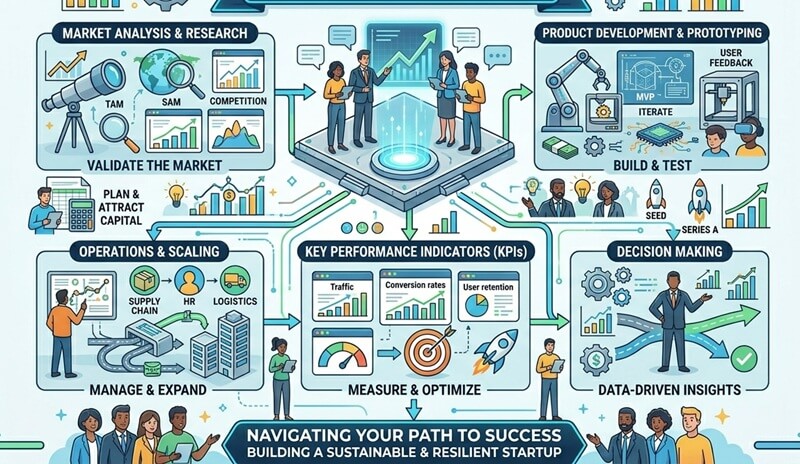
The founders who build the most effective tool stacks start from a problem definition rather than a tool selection. Before any software is evaluated, the question to answer is: what are the three or four most significant operational or growth constraints in the business right now? The tools worth adopting are the ones that directly address those constraints. Tools that are interesting but do not address a current constraint belong on a watch list, not in the active stack.
This approach requires honesty about what the business actually needs at its current stage, which is harder than it sounds. The instinct to build the stack you will need at ten times your current scale is powerful and consistently expensive. A pre-revenue startup with four people does not need the same customer data infrastructure as a company with ten thousand monthly active users. Adopting Salesforce before you have a sales team, or Mixpanel before you have enough product engagement data to analyse meaningfully, does not prepare you for growth. It creates maintenance overhead without producing insight.
The Four Questions Every Tool Must Answer Before Adoption
The first question is: what specific problem does this tool solve, and is that problem actually one of my top three constraints right now? If the answer requires a stretch to connect the tool to a real, present operational problem, the tool is probably not the right adoption at this moment.
The second question is: what existing tool does this replace or complement, and have I fully used the tool it is replacing before deciding it is insufficient? Tool proliferation often happens not because the existing platform lacks the required functionality but because the team has not invested the time to discover and use that functionality. Many founders switch from a tool they are using at 20 percent of its capacity to a new tool they will also use at 20 percent of its capacity, and pay more for the privilege.
The third question is: what data does this tool produce, and where does that data need to go for it to be actionable? A tool that generates data that no one in the team has time to review, or that cannot be connected to the platforms where decisions are made, produces information asymmetry rather than insight. The tool’s value is in the decisions it informs, not in the metrics it generates.
The fourth question is: what is the total cost of this tool, including setup time, learning curve, ongoing maintenance, and the monthly subscription, and does that total cost produce a return that is visible within 90 days? For a bootstrapped startup with constrained resources, a tool whose return requires six months to materialise is a tool that competes with payroll for cash. The 90-day return test is aggressive but honest.
Rather than thinking about tools as a list of products, it is more useful to think about a startup’s tool stack as a set of functional layers, each with a specific job, each needing to connect to the adjacent layers. Understanding the layers and their relationships makes tool selection decisions considerably more coherent than evaluating platforms in isolation.
Layer One: Measurement and Analytics
Measurement is the foundation of the entire stack. Without reliable data on where users come from, what they do inside the product, and when they leave, every other growth decision is guesswork. The analytics layer needs to answer three distinct questions: where is traffic coming from, what are users doing once they arrive, and what predicts whether a user becomes and stays a customer.
For most early-stage startups, Google Analytics 4 is the non-negotiable starting point. It is free, connects directly to Google Ads and Search Console, and provides sufficient acquisition and behaviour data for a pre-revenue or early-revenue company. Its learning curve is steeper than its predecessor, Universal Analytics, but the depth of its event-based tracking is meaningfully better for startups focused on conversion optimisation.
The gap that GA4 leaves is product analytics: understanding what users do inside the product after they sign up or purchase. For startups with a digital product, adding a product analytics tool like Mixpanel, Amplitude, or PostHog fills this gap. Mixpanel is strong for user flow analysis and cohort-based retention tracking. Amplitude is better suited to companies doing systematic product experimentation. PostHog is open-source and well-suited to startups that want full control over their data and have basic engineering resources to manage self-hosting.
The critical integration point for the measurement layer is its connection to the customer data layer. When the analytics platform shares user identifiers with the CRM and the email platform, the startup can connect acquisition source to customer lifetime value, which is the insight that determines which marketing channels are genuinely worth investing in and which are producing the wrong kind of customer.
Layer Two: Customer Acquisition and Conversion
The acquisition layer is where most startups spend the majority of their tool budget and get the least systematic value. This is because acquisition tools are adopted in response to channel experiments rather than as part of a coherent architecture. A startup tests paid search, adopts a Google Ads account. They try content, adopt a keyword research tool. They explore email outreach, adopt an outreach platform. The result is a fragmented acquisition infrastructure where performance data lives in multiple places and cannot be consolidated into a view of which channels actually produce customers worth keeping.
The starting principle for the acquisition layer is that every channel’s performance should be measurable against the same denominator: customer lifetime value divided by customer acquisition cost, with the data flowing back to the measurement layer to inform that calculation. This means the acquisition tools need to be integrated with the analytics platform and the CRM from the beginning, not after the channels are already running.
For SEO-driven acquisition, the foundational tool combination is Google Search Console, which is free and provides direct data on search performance, combined with one of Ahrefs, Semrush, or Ubersuggest depending on budget. Ahrefs provides the most reliable backlink data and content gap analysis. Semrush is stronger for paid search competitive intelligence. Ubersuggest is the most affordable entry point for keyword research at the pre-revenue stage.
For conversion optimisation, the most valuable addition to GA4 at early stage is a session recording and heatmap tool. Microsoft Clarity is completely free and provides session recordings, click maps, and scroll depth data that reveals where users are dropping off in ways that the GA4 funnel reports do not. Hotjar provides the same functionality at a modest cost with a somewhat cleaner interface and additional survey features. Either is a significant improvement over relying on aggregate traffic data alone.
Also read: AI Transformation Is a Problem of Governance: Why Technology Is Never the Real Issue (2026)
Layer Three: Customer Relationship and Revenue Management
The CRM is the central nervous system of the growth navigate stack. It is where customer data from the acquisition layer connects to the retention and communication layers, and where the business’s understanding of its customers accumulates over time. A startup without a functioning CRM is not running a customer relationship. It is running a series of disconnected customer interactions with no memory between them.
HubSpot’s free CRM tier is the most commonly recommended starting point for early-stage startups, and the recommendation is well-founded. It is genuinely capable at no cost, it connects to the most widely used marketing and communication tools, and its upgrade path is coherent as the team and the complexity of the sales process grow. Its limitation is that the free tier is designed to make upgrading feel necessary, and several of the features that become most valuable at moderate scale, marketing automation and advanced reporting in particular, are only available on paid plans that carry meaningful monthly costs.
For revenue tracking and subscription management, startups selling recurring products should implement Stripe or Paddle from the beginning and connect them directly to the CRM and the financial layer. The revenue data flowing from the payment platform is what drives the financial model, what feeds the customer lifetime value calculation in the analytics layer, and what triggers the retention workflows in the email platform. A startup whose revenue data lives only in a payment platform dashboard and is not connected to the rest of the stack is operating with the most important data in the business in a silo.
Layer Four: Communication and Retention
Customer retention begins the moment after the first purchase, and the communication layer is what determines whether a customer who made one purchase becomes a customer who stays. The tools in this layer include email marketing platforms, in-app messaging systems, and customer support infrastructure. Their shared job is to maintain the relationship between the startup and the customer at every point in the customer lifecycle.
Email marketing remains one of the highest-return channels available to startups, and the platform choice matters primarily in two dimensions: the quality of its automation capabilities and the depth of its integration with the CRM. Mailchimp is the most recognisable name in the category and provides a capable free tier for small lists. Its automation features become meaningfully more powerful at paid tiers, and its CRM integration with HubSpot and other platforms is reliable. Brevo, formerly known as Sendinblue, offers transactional email, SMS, and basic CRM functionality in a single platform at a lower price point than Mailchimp’s paid tiers, which makes it a strong choice for startups that need multi-channel communication without the complexity of managing separate platforms.
For startups with a digital product where in-app communication matters, Intercom provides the most comprehensive combination of in-app messaging, customer support, and lifecycle automation in a single platform. Its pricing is significant at scale, which makes it most suitable for companies that have validated product-market fit and are investing in retention rather than still testing it. For pre-PMF companies, a shared inbox tool like Missive or Front, combined with Mailchimp for lifecycle emails, provides adequate communication infrastructure at a fraction of the cost.
Layer Five: Operations and Financial Visibility
The operations layer is often the most neglected in early-stage startup stacks because it does not directly produce revenue. It is also the layer whose weakness most consistently produces the crises that derail growth. A startup that does not know its current cash balance with confidence, that cannot see its burn rate against its revenue trajectory, or that loses productivity to untracked tasks and disconnected project management is consuming operational overhead that compounds as the team grows.
For project management, Notion and Linear represent different approaches suited to different team types. Notion is a flexible documentation and project management tool that works well as a single source of truth for company knowledge, process documentation, and lightweight project tracking. It is most effective when the team commits to using it as the primary knowledge base. Linear is a more structured engineering and product management tool, designed specifically for software development workflows, with cleaner sprint management and issue tracking than Notion’s more flexible database approach. Many startups use both: Linear for product and engineering work, Notion for everything else.
For financial visibility, the most important integration in the entire stack is between the payment platform and the financial tracking tool. Puzzle.io is built specifically for SaaS startups and connects directly to Stripe, providing real-time financial statements, burn rate tracking, and MRR reporting in a format that is actually legible to non-accountants. Bench provides bookkeeping as a managed service for startups that do not want to manage it themselves. At the point where a startup has multiple revenue streams, significant payroll, and investors asking for financial reports, a fractional CFO or a more sophisticated financial management tool like Mosaic becomes the appropriate next step.
The Right Stack at Each Growth Stage: A Practical Reference
The most common and most expensive mistake in startup tool selection is adopting tools appropriate for a later stage than the one you are currently in. What follows is a practical breakdown of the recommended stack at three distinct growth stages, with the budget ranges that are appropriate at each.
| Tool Layer | Pre-Revenue Stage | Early Revenue Stage | Scaling Stage |
| Analytics | GA4 free tier only | GA4 plus Hotjar or Microsoft Clarity | GA4 plus Mixpanel or Amplitude for product analytics |
| CRM | Notion or Airtable free | HubSpot free CRM | HubSpot paid or Salesforce Starter |
| Email Marketing | Mailchimp free tier | Brevo or ConvertKit | ActiveCampaign or HubSpot Marketing |
| Automation | Zapier free (5 Zaps) | Zapier Starter or Make.com | Make.com or n8n for complex workflows |
| Project Mgmt | Notion free | Notion or Linear | Linear plus Notion for documentation |
| Finance | Spreadsheet plus Stripe dashboard | Puzzle.io or Bench | Pilot or full-service bookkeeping plus Mosaic |
| Communication | Slack free tier | Slack Pro | Slack Business plus or Google Workspace |
| Customer Support | Email shared inbox | Intercom Starter or Freshdesk | Intercom or Zendesk at scale |
| SEO and Content | Google Search Console plus Ubersuggest | Ahrefs or Semrush basic | Ahrefs or Semrush full suite |
| Monthly Budget | Under $50 | $200 to $600 | $800 to $2,500 |
Integration Architecture: Why How Tools Connect Matters as Much as Which Tools You Choose
The word integration is one of the most overused and least understood in the startup software conversation. When a tool’s marketing page says it integrates with hundreds of platforms, it usually means it has a native Zapier connection. That is useful, but it is not the same as a deep, bidirectional data integration that keeps customer records synchronised across platforms in real time.
The integration points that matter most in a growth navigate stack are the ones where a decision depends on data from multiple platforms being combined. The decision about which marketing channel to increase spend on requires acquisition source data from the analytics platform to be combined with lifetime value data from the payment platform and retention data from the CRM. If those three data sources cannot be queried together, the decision is made on incomplete information regardless of how sophisticated each individual platform is.
For early-stage startups without dedicated engineering resources, Zapier and Make.com are the primary tools for building these integrations. Zapier is more intuitive and better suited to simple, linear workflows: when this happens in tool A, do this in tool B. Make.com, formerly Integromat, handles more complex conditional logic and multi-step workflows at a lower cost per operation than Zapier. The right choice depends on the complexity of the integrations required rather than on any inherent quality difference between the two platforms.
The integration that most startups delay too long is the connection between the payment platform and the CRM. Until this connection exists, the startup does not know which customers in its CRM are currently paying, what they are paying, and when they are most likely to churn. Building this integration early, even imperfectly, is more valuable than building it perfectly later. An imperfect but current view of customer revenue is more useful for decision-making than a perfect view that does not yet exist.
The integration that most startups over-engineer is the connection between the project management tool and every other platform. Automatic task creation from customer support tickets, automatic status updates from engineering pipelines, and automatic documentation from meeting recordings all sound useful. In practice, they produce noise rather than signal unless the team has already established consistent processes that these automations are augmenting. Automate human processes that already work consistently. Do not automate inconsistent processes and expect the automation to make them consistent.
GrowthNavigate.com operates as a curated directory of startup tools and resources, with the explicit goal of helping founders find platforms appropriate to their stage and their specific operational challenges. Its value is different from review aggregators like G2 or Capterra, which provide user ratings across large populations that include enterprise users whose needs and budgets differ significantly from early-stage startups.
The platform invites submissions from tool providers and curates the directory around what it describes as the startup ecosystem. For founders, this makes it a useful early-stage filter: the tools featured are generally those positioned for startup use cases rather than enterprise deployment. That does not replace the evaluation framework described earlier in this guide, but it narrows the field of tools worth evaluating and reduces the time spent reading enterprise software documentation to discover it is not designed for a team of five.
Using GrowthNavigate.com effectively means treating it as a discovery layer rather than a recommendation engine. The directory tells you which tools exist in a given category and how they are positioned. The decision about which to adopt should still be driven by the first-principles evaluation described above: does it address a current constraint, does it connect to the rest of the stack, and does it produce a visible return within 90 days?
The Mistakes That Consistently Waste Startup Tool Budgets
The patterns that lead to bloated, underperforming tool stacks are consistent enough across founders that they deserve direct attention. None of them are the result of poor judgment in isolation. Most are the predictable outcome of adopting tools without a coherent framework for what the stack is supposed to do.
The most expensive single mistake is adopting a tool to solve a problem the startup does not yet have. This manifests most often in CRM selection, where founders adopt Salesforce or a comparable enterprise platform in anticipation of a sales team that does not exist yet, and then spend months managing the complexity of a platform whose value is contingent on a scale of operation they have not reached. The cost is not just the subscription. It is the opportunity cost of the time spent configuring, learning, and maintaining a platform that provides no return at the current scale.
The second mistake is treating free tools as temporary placeholders rather than as primary infrastructure. Many of the most capable tools available to early-stage startups are free or nearly free: Google Analytics 4, HubSpot’s free CRM, Microsoft Clarity, Google Search Console, Notion’s free tier. Founders who dismiss these as inadequate and immediately adopt paid alternatives often discover that the paid alternatives provide functionality they are not yet using, while the free tools they dismissed would have been entirely adequate for another twelve months. Use free tools to their full capability before deciding they are insufficient.
The third mistake is adopting tools faster than the team can build consistent habits around them. A tool that is used inconsistently provides worse data than a simpler tool used consistently. A CRM where half the team logs customer interactions and half does not produces a misleading picture of the pipeline. An analytics platform where events are tracked inconsistently across different pages produces data that cannot be trusted for conversion analysis. The limiting factor for most early-stage startup stacks is not the capability of the tools. It is the team’s capacity to build reliable habits around using them.
The fourth mistake is failing to audit the stack quarterly. Tools that were adopted to solve a problem three months ago may have already solved it, and the subscription continues without providing incremental value. The average startup with two years of history has four to six subscriptions that are no longer actively used or are redundant with another platform in the stack. A quarterly audit that evaluates each tool against the same first-principles questions used to adopt it consistently produces cost savings and reduces the operational complexity of maintaining integrations between platforms that are no longer necessary.
The fifth mistake is choosing tools based on what better-funded competitors or adjacent startups are using rather than based on current needs. The tool stack that is appropriate for a venture-backed startup with a 50-person team and a dedicated operations function is not appropriate for a four-person bootstrapped company. Benchmark against your stage, not against a company that is two or three years ahead of you in its development.
The most significant development in the startup tool landscape over the past 18 months is not a new platform category. It is the integration of AI capabilities into existing platforms in ways that change what those platforms can do without requiring founders to adopt entirely new tools.
HubSpot, Notion, Intercom, Zapier, and most major startup platforms have embedded AI features that, when used deliberately, can meaningfully reduce the time cost of operating those platforms. HubSpot’s AI can generate follow-up email drafts from CRM notes. Notion’s AI can summarise meeting notes, generate project templates, and draft process documentation. Intercom’s Fin can handle a significant proportion of routine customer support queries without human intervention. These are not transformative AI capabilities. They are incremental productivity improvements that compound across a team.
The more significant AI shift for growth navigate startup tools is the emergence of AI-native analytics and experimentation platforms that can identify patterns in product and customer data faster than traditional analytics workflows. Tools like Amplitude’s AI forecasting, PostHog’s trend analysis, and emerging platforms built entirely on large language model interfaces for data querying are beginning to reduce the technical skill required to extract meaningful insight from product analytics data. For startups without dedicated data analysts, these capabilities represent genuine leverage.
The caution is that AI features are most valuable in tools the team is already using consistently. An AI feature in a CRM that the team updates irregularly produces AI-generated summaries of incomplete data. An AI assistant in a project management tool that teams use differently across departments produces inconsistent outputs. The discipline of using the existing stack well is a prerequisite for AI enhancements to deliver their promised value.
Frequently Asked Questions
Q1. What are growth navigate startup tools?
Growth navigate startup tools are the software platforms that directly affect a startup’s ability to acquire customers, retain them, understand their behaviour, and operate sustainably. They include analytics platforms, CRM systems, email marketing tools, automation software, and financial tracking applications. The term is associated with GrowthNavigate.com, a curated directory of startup tools and resources. The defining characteristic is that these platforms sit in the direct path between the startup and its customers, shaping how growth is measured, executed, and maintained.
Q2. What is GrowthNavigate.com and how is it useful for founders?
GrowthNavigate.com is a curated directory of tools and resources for startup founders and entrepreneurs. It accepts tool submissions from software providers and organises them around startup use cases. Its primary value for founders is as a discovery and filtering resource that focuses on startup-appropriate platforms rather than enterprise software. It narrows the field of tools worth evaluating in any given category, though the final selection decision should still be driven by the specific operational constraints and integration requirements of the individual startup.
Q3. How should a pre-revenue startup approach tool selection?
Pre-revenue startups should adopt the smallest number of tools that directly support their most important current activity: validating that someone will pay for what they are building. That typically means a simple website or landing page, Google Analytics 4 for basic traffic and conversion measurement, a shared email inbox or basic CRM for managing early customer conversations, and a payment platform like Stripe configured from the first transaction. Everything else should wait until there is a specific, present operational problem that justifies the adoption cost.
Q4. What is the most important integration in a startup tool stack?
The most important integration is between the payment platform and the CRM, because it connects revenue data to customer records. Until this integration exists, the startup cannot systematically connect which customers are paying, what they are paying, and how long they are staying, to the acquisition source that brought them in. Without that connection, marketing channel decisions are made without knowledge of which channels produce customers worth keeping, which is the most consequential analytical gap in an early-growth startup.
Q5. When should a startup upgrade from free tools to paid tools?
The right time to upgrade from a free tool to a paid tier is when the free tier’s specific limitations are directly preventing a current, important activity, not when the paid tier offers features that would be nice to have. This distinction matters because paid tool upgrades are often made in anticipation of features the team does not yet have the operational maturity to use. Most free tiers from major startup platforms provide adequate functionality for the first 12 to 18 months of a startup’s growth, and many founders switch too early.
Q6. How many tools does a typical early-stage startup actually need?
A functional early-stage startup stack typically requires between five and eight tools to cover the essential functions: analytics, CRM, email communication, project management, payment processing, and basic financial tracking. Stacks that grow beyond ten or twelve active tools before the company reaches significant scale almost always contain redundant platforms, tools solving problems that do not yet exist at scale, or subscriptions that were adopted for a specific project and never cancelled. Simplicity is a competitive advantage in early-stage operations.
Q7. What is the role of automation tools like Zapier in a growth navigate stack?
Automation tools like Zapier and Make.com serve as the connective tissue between platforms that do not have native integrations. Their primary value is in eliminating manual data transfer between systems, such as copying new customer records from a form into the CRM, or notifying a Slack channel when a payment fails. They are most effective when automating processes that already work consistently in manual form. Automating inconsistent processes does not make them consistent. It makes them consistently inconsistent at higher speed.
Q8. How does the right tool stack change as a startup scales?
The tool stack should evolve in response to specific new operational constraints rather than as a general upgrade to more sophisticated platforms. The transitions that typically require stack changes are: the move from founder-led sales to a sales team, which requires CRM features that the free tier does not provide; the growth of the customer base to a point where segmented lifecycle email automation is necessary for retention; and the complexity of financial reporting when investors or board members require structured financial statements. Each of these transitions has a corresponding tool upgrade that is appropriate at that stage.
Q9. How often should a startup audit its tool stack?
Quarterly is the appropriate frequency for a full stack audit. At each audit, every tool should be evaluated against the same questions used to adopt it: is it solving a current top-three constraint, is the team using it consistently, are the integrations functioning correctly, and is the return visible and proportionate to the total cost including team time? Tools that fail this evaluation should be cancelled or replaced. The average startup that audits quarterly consistently finds two to four tools that are no longer providing proportionate value.
Q10. How is AI affecting the startup tool landscape in 2025?
AI is primarily affecting the startup tool landscape through the integration of AI capabilities into existing platforms rather than through entirely new platform categories. HubSpot, Notion, Intercom, Zapier, and most major startup platforms now offer AI features that reduce the time cost of operating those platforms. More significantly, AI-native analytics tools are beginning to reduce the technical skill required to extract meaningful insight from product and customer data. The constraint on AI value in startup tools is the same as the constraint on all tools: AI features are only as good as the data quality and usage consistency of the platforms they are built into.
Conclusion
The question of which growth navigate startup tools to use is less important than the question of how to think about tool selection, integration, and iteration as a startup grows. The founders who build the most effective stacks are not the ones who have the most sophisticated platforms. They are the ones who are most disciplined about adopting tools in response to specific, present constraints rather than anticipated future needs.
GrowthNavigate.com and the broader ecosystem of startup tool resources exist to make tool discovery faster. They do not and cannot replace the work of understanding what your startup specifically needs at its current stage, what data needs to flow between which platforms for your most important decisions, and which tools the team will actually use consistently enough to produce reliable information.
The stack that works is the one that the team uses. The analytics that drive decisions are the ones that are current, accurate, and connected to the platforms where decisions are made. The automation that produces leverage is the automation that runs reliably on top of processes that already work. None of those outcomes follow automatically from choosing the right tools. They follow from choosing tools deliberately and using them with discipline.