
Ten years ago, learning how to use artificial intelligence meant enrolling in a computer science degree and sitting in a lecture hall for four years. Today, someone in a small town with a laptop and a decent internet connection can learn the same skills in a matter of weeks, apply them to real work, and build a career in a field that barely existed when they started.
That shift did not happen by accident. It is the result of a deep, structural change in how technology education works. And it is exactly what the droven io tech education trends conversation is really about.
Droven.io is an informational platform that publishes clear, beginner-friendly content on artificial intelligence, automation, cloud computing, and digital transformation. It does not sell courses or software. It explains technology in plain language that ordinary readers can absorb and actually use. That focus on accessible, practical knowledge puts it at the centre of one of the biggest shifts happening in education right now.
This article breaks down what those trends are, why they matter, where they are heading, and what you can do to keep up. Whether you are a student, a working professional, a business owner, or simply someone curious about where technology is going, what follows is the clearest map you will find.
Contents
- 1 What Droven IO Actually Is and Why It Fits This Moment
- 2 Why the Traditional Tech Education Model Is Breaking Down
- 3 The Eight Major Droven IO Tech Education Trends Reshaping Learning in 2026
- 3.1 Trend One: AI-Personalised Learning Is Replacing the One-Size-Fits-All Classroom
- 3.2 Trend Two: Micro-Credentials Are Overtaking Traditional Degrees for Tech Roles
- 3.3 Trend Three: Project-Based Learning Is Producing the Skills That Employers Actually Want
- 3.4 Trend Four: Automation Literacy Is Becoming a Basic Workplace Skill
- 3.5 Trend Five: Cloud Computing Knowledge Is Now a Core Career Asset
- 3.6 Trend Six: Evergreen Educational Content Is Winning Over Breaking Tech News
- 3.7 Trend Seven: Digital Transformation Literacy Is Reaching Non-Technical Professionals
- 3.8 Trend Eight: The Intersection of AI and Quantum Computing Is the Next Frontier
- 4 Tech Education Models Compared: Which One Is Right for You in 2026
- 5 What Droven IO Does Differently from Every Other Platform
- 6 How to Apply the Droven IO Learning Approach to Your Own Tech Education
- 7 Common Mistakes People Make When Following Tech Education Trends
- 8 Where Droven IO Tech Education Trends Are Heading Beyond 2026
- 9 Frequently Asked Questions
- 10 Conclusion
What Droven IO Actually Is and Why It Fits This Moment
Before getting into the trends, it is worth being precise about what Droven.io is, because most people who search for it do not fully understand its category.
Droven.io is not a university. It is not a bootcamp. It is not an online course marketplace like Coursera or Udemy. It is a knowledge hub. The platform publishes structured, well-organised articles that explain complex technologies in language that a non-technical reader can follow. Its core subject areas include artificial intelligence, robotic process automation, cloud computing, digital transformation, and future technology.
What makes the platform relevant to the education conversation is its underlying philosophy. Droven.io operates on the belief that technology literacy should not require a computer science background. It is built for the person who wants to understand AI well enough to use it in their work, not necessarily build it from scratch. That philosophy mirrors exactly what the broader tech education landscape is moving toward in 2026.
The platform also reflects something important about how people learn online today. Search behaviour around droven.io shows that readers are not just looking for news. They want understanding. They want to know what RPA is and how it works, not just that it exists. They want to know how AI affects their job, not just that it is advancing. Droven.io meets that demand directly, and that is why it has earned a genuine audience.
Why the Traditional Tech Education Model Is Breaking Down
The conventional path into technology looked like this: study a STEM subject at university, earn a degree, enter the workforce, and gradually build expertise on the job over several years. That model worked reasonably well for a few decades. It is now increasingly misaligned with how technology actually moves.
Technology changes faster than university curricula can update. A course designed two years ago may not mention tools that are now considered industry standard. A degree programme that takes four years to complete can produce graduates who are technically qualified on paper but practically behind from the day they graduate.
There is also a cost problem that is difficult to ignore. Higher education has become significantly more expensive relative to the return it provides, particularly in technology fields where practical skills and demonstrated output carry far more weight in hiring than academic credentials. Employers across the world are increasingly saying this out loud.
Google, IBM, Apple, and hundreds of smaller technology companies have publicly removed degree requirements from many of their technical roles. What they are asking for instead is evidence. Show us what you built. Show us what you know how to do. Show us that you can solve the problem in front of you right now.
The result is a growing population of learners who are bypassing traditional routes entirely. They are using platforms like Droven.io to build foundational understanding, combining that with targeted short courses, building projects to demonstrate capability, and entering the workforce on the strength of what they can show rather than what a certificate says. This is not a fringe behaviour anymore. It is the mainstream.
The Eight Major Droven IO Tech Education Trends Reshaping Learning in 2026
These are not speculative ideas or wishful thinking. Each of the following trends is supported by real data, visible changes in industry hiring behaviour, and the specific direction that platforms like Droven.io are moving. Together they form a complete picture of where technology education is going.
Trend One: AI-Personalised Learning Is Replacing the One-Size-Fits-All Classroom
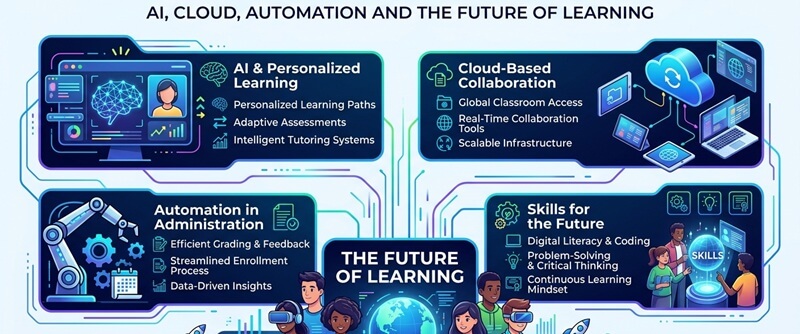
Artificial intelligence is no longer just a subject being taught in education. It is becoming the infrastructure through which education is delivered. Adaptive learning platforms now analyse how a student reads, where they slow down, which concepts they revisit multiple times, and what formats they engage with most deeply. They then adjust the content in real time.
According to Forbes, approximately 60 percent of educators already use AI in some form in their daily teaching practice. That number is growing sharply and is expected to continue through 2026 and beyond. For platforms like Droven.io, this trend validates their core approach. Readers do not all arrive with the same background knowledge or the same learning pace, so content must be layered, accessible, and written to meet people where they actually are rather than where a curriculum assumes they should be.
Trend Two: Micro-Credentials Are Overtaking Traditional Degrees for Tech Roles
The belief that you need a four-year degree to work in technology is collapsing, and it is collapsing fast. Micro-credentials, which are short certificates earned by completing a specific skill-based course or assessment, are filling the gap that traditional qualifications are leaving behind. They are faster, significantly cheaper, and increasingly accepted by hiring managers who care more about demonstrated ability than institutional affiliation.
The World Economic Forum’s Future of Jobs Report identifies this shift as one of the defining workforce changes of the decade. Learners who combine foundational reading from platforms like Droven.io with targeted micro-credentials in a specific area are building genuinely competitive profiles, often in a fraction of the time and cost of a traditional degree.
Trend Three: Project-Based Learning Is Producing the Skills That Employers Actually Want
There is a growing and well-documented gap between what formal education teaches and what technology employers actually need from new hires. The answer emerging across bootcamps, self-directed learners, and progressive online platforms is project-based learning. Instead of studying theory and sitting an exam, learners build things. They create an automation script. They deploy a cloud function. They train a simple AI model. They put the results somewhere visible.
This approach does something that traditional education consistently fails to do: it produces proof. A GitHub repository full of real projects tells an employer more about a candidate than a transcript ever could. Droven.io supports this trend by explaining how technologies actually work in practice, giving learners the conceptual foundation they need to go and build something real with what they have learned.
Trend Four: Automation Literacy Is Becoming a Basic Workplace Skill
Robotic process automation is no longer a concern only for IT departments. It is spreading rapidly into finance, operations, customer service, healthcare administration, and logistics. Businesses are automating repetitive tasks at scale, and this is creating a new kind of literacy requirement for workers across every function, not just technical ones.
Workers who previously had no technical background are now expected to understand automation concepts, work comfortably alongside bots, and in many cases configure simple automated workflows themselves. Droven.io’s detailed, beginner-friendly content on RPA is a direct response to this reality. The platform walks readers through the core logic of automation in four stages: identifying which tasks to automate, understanding how workflow creation works, knowing what bot training involves, and grasping how execution monitoring functions. That kind of structured, plain-language explanation is exactly what this audience needs.
Trend Five: Cloud Computing Knowledge Is Now a Core Career Asset
The global cloud computing market is projected to surpass one trillion dollars by 2028. Every business that stores data, runs software, or communicates digitally is now dependent on cloud infrastructure in some form. That dependency is creating enormous demand for people who understand how cloud systems work, even at a conceptual rather than deeply technical level.
Understanding the practical difference between AWS, Azure, and Google Cloud, knowing what infrastructure-as-a-service means in real terms, and grasping the basics of DevOps is now expected across roles that were never considered technical five years ago. Project managers, operations analysts, marketing leads, and HR professionals are all being asked to engage with cloud systems as part of their daily work. Droven.io’s content on cloud computing helps bridge the knowledge gap for exactly these readers.
Trend Six: Evergreen Educational Content Is Winning Over Breaking Tech News
There is an important and underappreciated distinction between content that explains and content that reports. Most technology publications report. They cover product launches, funding rounds, executive moves, and weekly rankings of the hottest new tools. That content is valuable in the moment and largely forgotten within a week.
Droven.io has built its platform on a different model. Articles that explain what AI is, how automation works at a process level, and why quantum computing matters are just as useful six months after publication as they are the day they go live. This is the evergreen model. Learners who discover one of these articles three years from now will find it just as readable and useful as someone who finds it today. This approach reflects something real about how people actually want to learn: they want to build a mental model, not just stay current with headlines.
Trend Seven: Digital Transformation Literacy Is Reaching Non-Technical Professionals
Digital transformation is no longer the exclusive concern of CTOs and IT directors. Marketing managers, operations leads, HR professionals, and small business owners are now expected to understand what digital transformation means, what it requires, and how to navigate it in their own context. The challenge is that most of the content written about digital transformation is written for technical audiences and is effectively inaccessible to everyone else.
This is the exact gap that platforms like Droven.io are designed to fill. By explaining complex transformation concepts without assuming prior technical knowledge, the platform extends technology education to audiences who were previously locked out of it. This democratisation of technology literacy is one of the most significant structural changes happening in education right now, and it is still very early.
Trend Eight: The Intersection of AI and Quantum Computing Is the Next Frontier
While most of today’s tech education focuses on AI and automation tools that exist right now, the next wave is already forming in research labs and early commercial deployments. Quantum computing combined with artificial intelligence promises processing power and data interpretation capabilities that will make today’s AI models look elementary by comparison.
Droven.io has begun covering this intersection, which positions it ahead of the curve for readers who want to understand what is coming before it arrives. For learners and professionals, understanding the basics of quantum computing today is the equivalent of understanding cloud computing in 2012. It is not immediately essential. But the people who have that foundational knowledge when it becomes mainstream will be the ones who lead.
Tech Education Models Compared: Which One Is Right for You in 2026
Not every learner needs the same approach, and not every approach produces the same outcome. The table below gives a clear overview of the main paths available in 2026 and what each one is genuinely best suited for.
| Learning Model | Format | Time | Best For | Proof of Skill |
| Traditional Degree | Campus / in-person | 3 to 4 years | Deep theoretical base | Diploma |
| Online Degree | Self-paced video | 2 to 4 years | Flexible full qualification | Degree certificate |
| Bootcamp | Intensive, cohort-based | 3 to 6 months | Career switchers | Portfolio + certificate |
| Micro-credential | Short course or module | Days to weeks | Upskilling on specific tools | Badge or certificate |
| Project-based | Self-directed building | Ongoing | Hands-on learners | Portfolio or GitHub |
| Knowledge Hub Model | Articles and guides | Read at own pace | Beginners and curious readers | Understanding applied |
What Droven IO Does Differently from Every Other Platform
There are hundreds of platforms that teach technology. Coursera, Udemy, edX, LinkedIn Learning, and Khan Academy all offer structured courses with video lectures, assessments, and certificates. YouTube channels provide free tutorials on virtually every tool imaginable. Bootcamps offer intensive programmes for people who want to switch careers quickly. So where does Droven.io actually fit, and why does it attract a distinct kind of reader?
The answer is in what it does not do. Droven.io does not require you to enrol, pay, or commit to a learning path. It does not assume you already know what RPA stands for or what the difference is between supervised and unsupervised machine learning. It meets readers at the very beginning and takes them through the logic of a technology in a way that is organised, readable, and genuinely free of jargon.
That positions it as a first stop rather than a complete education. And that role is genuinely valuable, perhaps more valuable than most people realise. Before a person can decide which cloud certification to pursue, they need to understand what cloud computing is and why it matters in their specific context. Before they can choose an AI course, they need a working mental model of how AI actually functions. Droven.io provides that foundation, and without it, a lot of the structured learning that comes after makes far less sense.
This is also why the platform’s commitment to evergreen content is strategically sound from both an editorial and a business perspective. Foundational knowledge does not expire. An article explaining how machine learning works is just as useful to a reader today as it was eighteen months ago. By focusing on fundamentals rather than trending news cycles, Droven.io builds long-term trust with its audience rather than chasing short-term traffic spikes.
How to Apply the Droven IO Learning Approach to Your Own Tech Education
Understanding the trends is one thing. Knowing what to actually do with that understanding is another. Here is a practical framework, grounded in the droven io tech education trends, for building real technology skills in 2026.
The first thing to do is build conceptual understanding before you choose a course, a bootcamp, or a certification. Read foundational articles. Understand what AI is actually doing at a process level. Understand how automation works before you decide which automation tool to learn. Understand what cloud computing means for a business before you start a cloud certification. Skipping this step and jumping straight into technical training is one of the most consistent mistakes that learners make, and it usually results in expensive course enrolments that do not stick.
The second step is to choose one track and commit to it fully. The biggest trap in tech education is trying to learn everything at once. AI, automation, cloud, cybersecurity, software development, and data science all sound essential. They are all relevant. But attempting to learn them all simultaneously almost always means learning none of them well. Pick one area. AI and automation, cloud and DevOps, or data and analytics are all strong starting points for 2026. Stay in that lane for at least three months before evaluating whether to expand.
The third step is to move from reading to building as quickly as possible. Conceptual knowledge needs to be turned into applied skill. Once you understand how something works, build something with it, however small. Automate a task you do repeatedly at work. Deploy a simple application on a cloud platform. Use an AI tool to solve a real problem you actually have. The project does not need to be impressive. It needs to be real, documented, and yours.
The fourth step is to document what you learn and what you build. One of the most underrated skills in the entire technology field is the ability to explain clearly what you built and why. Write a short article about a project. Create a walkthrough video. Write a README for your code repository. This documentation habit forces you to genuinely understand what you did, and it creates visible evidence of your capability that you can show to anyone who asks.
The fifth and final step is to stay current without getting distracted. Technology moves fast, but fundamentals move slowly. Spend the majority of your learning time on skills and concepts that will still be relevant in five years. Spend a smaller portion staying current with emerging tools and new developments. Platforms like Droven.io are excellent for the fundamentals. Follow two or three trusted industry sources for the current landscape. That balance protects your learning time from being consumed by novelty.
Common Mistakes People Make When Following Tech Education Trends
Getting the strategy right matters as much as choosing the right content. These are the mistakes that consistently derail learners who are otherwise on the right track.
The most common mistake is chasing certifications without building projects alongside them. A certificate tells a potential employer you completed a course. A portfolio of real projects tells them you can actually do the work. In 2026, most hiring managers in technology roles care far more about the latter. Certifications are valuable as supporting evidence. They are not sufficient on their own.
A closely related mistake is learning theory without applying it. Reading about AI is not the same as using AI. Watching a video on cloud deployment is not the same as deploying something. Every concept you learn should be followed as quickly as possible by an attempt to apply it, however imperfect that attempt may be. The gap between understanding and doing is where most learners stall indefinitely.
Another pattern that consistently undermines learners is trying to follow every trending tool at once. New AI tools, new cloud services, and new automation platforms emerge every week. Chasing each one leads to surface-level familiarity with a very large number of things and genuine competence in nothing. Depth beats breadth at the beginning. Breadth becomes relevant once depth is established.
Many learners also make the mistake of waiting until they feel fully ready before starting to build. This readiness never arrives because the more you learn, the more you realise you do not yet know. Build before you feel ready. The understanding deepens through practice, not through further preparation. This is one of the most consistently supported findings in learning science and one of the most consistently ignored pieces of advice.
Finally, a surprising number of people dismiss foundational content as too basic once they have been learning for a few months. Articles that explain what AI is and how automation works at a process level are not just for absolute beginners. They are the foundation on which everything else is built. Revisiting fundamentals with the benefit of some experience is not a step backward. It is a mark of sophisticated, intentional learning.
Where Droven IO Tech Education Trends Are Heading Beyond 2026
The trends visible in 2026 are not the destination. They are an early stage in a much longer transformation. The changes in technology education are still accelerating, and the next three to five years will look significantly different from today.
AI Tutors Will Become the Standard, Not the Exception
Adaptive AI tutors that adjust content, pacing, and format in real time based on individual learner behaviour are already in early deployment across several major platforms. By 2027, personalised AI instruction is likely to be the default experience on most serious learning platforms rather than a premium feature. This will make high-quality technology education accessible to learners who currently cannot afford structured programmes, which is a genuinely significant social development.
The Portfolio Will Replace the Degree as the Primary Hiring Signal
This shift is already well underway among technology companies. Within five years, a well-documented portfolio of real projects is likely to carry more weight than a degree from most universities for most technology roles. The institutions that will retain their premium are the elite research universities at the very top of the market. For the vast majority of technology hiring, demonstrated capability will matter more than institutional affiliation.
Automation Literacy Will Be Expected Across All Professions
Just as word processing literacy became a universal expectation in the workplace during the 1990s, automation literacy is on track to become a basic professional requirement across virtually every industry. Understanding how to work with automated systems, configure simple workflows, and interpret outputs from AI tools will be as fundamental to professional life as knowing how to use a spreadsheet is today. Workers who develop this literacy now are building a durable career advantage.
Quantum Computing Education Will Enter the Mainstream
Quantum computing is currently the domain of researchers, specialist engineers, and a relatively small number of forward-looking educators. Within five to seven years, as quantum applications begin entering commercial use in pharmaceuticals, logistics, finance, and cybersecurity, demand for quantum literacy will spread into a much broader professional audience. Platforms that are already building accessible quantum content, as Droven.io has begun to do, will be well positioned for that transition.
The Knowledge Hub Model Will Scale Globally
The model that Droven.io represents, trustworthy, beginner-accessible, evergreen educational content on emerging technology, is still relatively uncommon at the quality level required to build genuine authority and sustained readership. As demand for this type of content grows in markets outside the United States, including South Asia, Southeast Asia, Latin America, and Sub-Saharan Africa, there is significant opportunity for platforms that can deliver it consistently in plain, accessible language.
Frequently Asked Questions
Q1. What does droven io tech education trends mean?
Droven IO tech education trends refers to the broader shift in technology learning that Droven.io reflects and covers through its content. This includes the move toward skill-based learning, micro-credentials, AI-personalised education, project-based portfolios, automation literacy for non-technical workers, and accessible content on emerging technologies like AI, cloud computing, and RPA. It describes how people are learning technology in 2026 rather than referring to a specific course or programme.
Q2. Is Droven.io a legitimate platform for tech education?
Droven.io is a legitimate informational platform that publishes structured, educational content on AI, automation, cloud computing, and digital transformation. It is not an accredited institution and does not offer formal qualifications. Its value lies in providing clear, accessible foundational knowledge for readers who want to understand modern technology without needing a technical background. It functions best as a starting point or a complement to structured learning rather than a standalone qualification pathway.
Q3. What are the most important tech education trends in 2026?
The most significant trends in 2026 include AI-personalised learning adapting content to individual learners in real time, micro-credentials replacing degrees for many technology roles, project-based skill development producing portfolio evidence that employers value, automation literacy spreading across non-technical professions, cloud computing knowledge becoming a core career asset, and evergreen educational content gaining sustained readership over breaking tech news.
Q4. How is Droven.io different from Coursera or Udemy?
Droven.io is not a course platform. It does not require enrolment, payment, or commitment to a structured learning path. It is a knowledge hub that publishes free, structured articles explaining technology concepts in beginner-friendly language. Coursera and Udemy are structured course providers with video lectures, assessments, and formal certificates. Droven.io works best as a foundation-building resource before or alongside those platforms, providing the conceptual understanding that makes structured courses more effective.
Q5. Can I build a tech career using platforms like Droven.io alone?
Not entirely on its own. A knowledge hub like Droven.io is excellent for building conceptual understanding and staying informed about technology trends. But a career in technology also requires hands-on practice, real project development, and usually some form of skill validation through a short course, bootcamp, or recognised certification. The most effective approach is to use Droven.io as your conceptual foundation, combine that with project work, and add targeted credentials in your chosen area.
Q6. What is a micro-credential and why is it growing in tech education?
A micro-credential is a short, focused certificate earned by completing a skill-specific course or passing a defined assessment. They are growing rapidly because employers are increasingly hiring based on demonstrated skills rather than degrees, and because technology moves faster than university curricula can update. Micro-credentials allow learners to upskill quickly in specific tools or concepts that are directly relevant to current job market demand, often in a fraction of the time and cost of a traditional qualification.
Q7. How should a complete beginner approach tech education in 2026?
Start by building a conceptual foundation through accessible platforms like Droven.io. Understand what AI, automation, and cloud computing actually do before choosing a specific tool or course. Then pick one area to focus on, commit to consistent daily learning of around 30 minutes, and begin building a small project as soon as possible. Document everything you build. A portfolio of real, documented projects is more valuable to most tech employers in 2026 than any single qualification.
Q8. Why is automation literacy important for non-technical workers?
Automation is spreading from IT departments into finance, HR, marketing, operations, customer service, and logistics. Workers across these functions are increasingly expected to understand how automated workflows function, how to work productively alongside automated systems, and in many cases how to configure simple automations themselves. Automation literacy is becoming a basic professional skill in the same way that spreadsheet literacy became universal in the 1990s.
Q9. What is the future of tech education beyond 2026?
The most significant changes expected include AI tutors becoming the default learning experience on major platforms, portfolios replacing degrees as the primary hiring signal for most technology roles, automation literacy becoming a universal professional expectation across all industries, quantum computing education entering mainstream awareness as commercial applications emerge, and knowledge hub platforms scaling to serve growing learner populations in South Asia, Southeast Asia, and Latin America.
Q10. How often should someone update their tech skills in 2026?
Continuously but strategically. Spend the majority of your learning time on fundamentals that will remain relevant over several years: how AI systems work conceptually, cloud architecture basics, automation logic, and data thinking. Spend a smaller portion staying current with specific tools and industry developments. A practical approach is 30 minutes of daily learning focused on fundamentals, combined with a weekly scan of two or three trusted sources for current developments in your chosen area.
Conclusion
The story of droven io tech education trends is ultimately the story of a larger transformation that is still very much in progress. The walls that once kept technology education inside universities and specialist institutions are coming down. Content that explains complex technology in plain, honest language is no longer a secondary option for people who could not afford a proper education. It is the foundation on which a new generation of self-directed, skill-focused learners is building real, sustainable careers.
Droven.io represents one important part of this ecosystem. It is the place you go to understand something before you go somewhere else to learn how to do it. It does not replace structured learning. It makes structured learning significantly more effective by ensuring that learners arrive with the conceptual foundation they need to absorb and apply what they are taught rather than just memorising it for an assessment.
For anyone reading this, the practical takeaway is straightforward. Start with genuine understanding. Then build something real. Document what you built. Repeat this consistently over time. The combination of foundational knowledge, applied projects, and documented output is the most reliable path through the technology education landscape of 2026.