
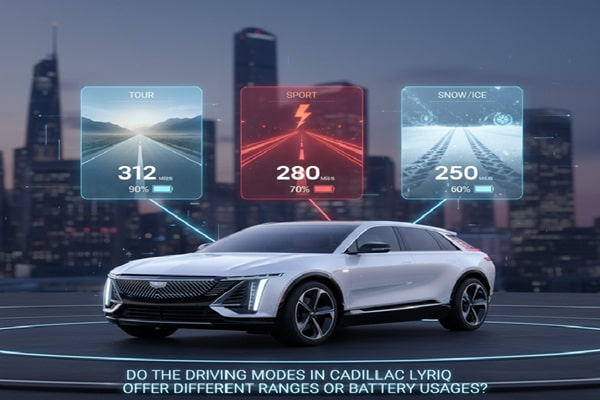
Yes. The driving modes in the Cadillac LYRIQ directly affect how quickly the battery drains and how far you can drive on a single charge. The battery pack itself stays the same size across every mode, but the rate at which energy is drawn from it changes significantly depending on which mode you select, how you drive within that mode, and what conditions you are driving in. Tour Mode delivers the best real-world range. Sport Mode can reduce range by 10 to 20 percent or more. Snow/Ice Mode adds a safety-first power delivery that indirectly affects efficiency. My Mode puts the control entirely in your hands.
This guide explains exactly how each mode works, what is actually happening inside the drivetrain when you switch modes, how many miles you realistically gain or lose, and which mode to use in every driving situation.
Contents
- 1 First: What the Battery Does Not Change
- 2 The Four Driving Modes Explained
- 3 One-Pedal Driving and Regen on Demand: Range Multipliers in Every Mode
- 4 The 2026 Lyriq-V: Velocity Max and V-Mode
- 5 Real-World Range Estimates by Mode
- 6 What Affects Range More Than Mode Selection
- 7 Practical Guide: Which Mode to Use When
- 8 Common Mistakes LYRIQ Owners Make With Driving Modes
- 9 Frequently Asked Questions
- 10 Key Takeaways
- 11 Conclusion
First: What the Battery Does Not Change
Before getting into the modes, one thing needs to be clear because most articles skip it.
When you switch from Tour to Sport, the battery does not get bigger or smaller. The Cadillac LYRIQ is built on GM’s Ultium platform with a 102 kWh battery pack. That capacity is fixed. What the driving modes change is the software calibration governing how the electric motors request energy from that battery.
Think of it this way. You have a tank of water. The tank is always the same size. But you can attach different nozzles. A wide nozzle drains the tank quickly. A narrow nozzle extends how long the water lasts. Driving modes are the nozzles. The battery is the tank.
The specific calibrations that change between modes include throttle mapping curves, regenerative braking strength, traction control intervention thresholds, steering resistance levels, and in AWD models, whether and how aggressively the front motor gets engaged. Each of these has a direct or indirect effect on energy consumption.
The Four Driving Modes Explained
Tour Mode: The Efficiency Baseline
Tour Mode is the default setting on the LYRIQ and the one most closely aligned with the EPA-estimated range figures you see on the window sticker.
The throttle mapping in Tour Mode is progressive and linear. When you press the accelerator, power builds gradually rather than arriving all at once. This matters enormously for battery efficiency because the largest energy expenditure in any electric vehicle happens during rapid acceleration events. A smooth, progressive power request draws far fewer kilowatts at any given moment than a sharp, aggressive one.
In Tour Mode, the LYRIQ is calibrated to discourage power spikes without limiting the car’s capability. The car can still accelerate quickly when needed. It just does not default to treating every light-press of the pedal as a demand for maximum torque.
Real-world range in Tour Mode for the rear-wheel-drive LYRIQ is approximately 307 to 314 miles under mixed driving conditions at moderate speeds. The EPA estimate for the RWD model is 314 miles. Drivers who maintain smooth habits on consistent routes often report figures within 5 to 10 percent of that number.
Tour Mode is the right choice for daily commuting, highway road trips, mixed city and suburban driving, and any situation where maximizing range is the primary goal.
Sport Mode: Performance at a Cost
Sport Mode is where the LYRIQ shows its personality as a luxury performance EV, and where range takes the most significant hit.
When you switch to Sport Mode, the throttle mapping changes dramatically. The relationship between pedal position and motor output becomes sharper and more immediate. A quarter-inch of pedal travel in Sport delivers power that would require three-quarters of an inch in Tour. The result is a car that feels dramatically more responsive and exciting to drive.
From an energy standpoint, that sharpness is expensive. The electric motors in Sport Mode are ready to deliver high torque at any moment, which means the battery management system keeps power pathways primed and available. Even before you actually accelerate hard, the system is consuming slightly more energy to maintain that state of readiness.
When you do accelerate in Sport Mode, the instantaneous kilowatt draw spikes much higher than in Tour. These power spikes generate more heat in the battery and motors, and heat is wasted energy. More heat means more energy consumed per mile.
The practical range reduction in Sport Mode for most drivers falls between 10 and 20 percent compared to Tour Mode. In concrete terms on a LYRIQ with a 307-mile Tour range, that translates to roughly 245 to 275 miles in Sport Mode under similar driving conditions. Aggressive, spirited use of Sport Mode can push that reduction beyond 25 percent.
There is an important nuance here that most articles miss entirely: a disciplined driver in Sport Mode can approach Tour Mode efficiency. The mode adjusts the car’s potential, not the driver’s behavior. If you activate Sport Mode but drive with the same gentle, progressive throttle inputs you would use in Tour Mode, the energy penalty is much smaller than it would be if you were driving the way Sport Mode invites you to.
The reverse is also true. An aggressive driver in Tour Mode who accelerates hard repeatedly will see worse range than a calm driver in Sport Mode. Mode shapes the car’s responsiveness. Behavior determines actual consumption.
Sport Mode is best suited for short spirited drives, specific highway sections where you want responsive merging capability, or situations where the driving experience is prioritized over range. It is not the mode to use when starting a long trip with limited charging options along the route.
Snow/Ice Mode: Safety First, Efficiency Second
Snow/Ice Mode was not designed with range optimization in mind. Its purpose is traction control and driver safety on low-grip surfaces.
When activated, Snow/Ice Mode significantly reduces the power delivery on initial acceleration. This prevents the kind of sudden torque spikes that cause wheel spin on ice or snow-covered roads. The car launches from a stop more gently and the traction control system intervenes more aggressively when wheel slip is detected.
From a pure energy perspective, Snow/Ice Mode’s power reduction actually resembles Tour Mode in some ways. Preventing wheel spin means preventing wasted energy. Wheel spin dissipates kinetic energy as heat through friction without moving the car forward, which is among the least efficient things an electric drivetrain can do.
However, Snow/Ice Mode is almost always used in cold weather, and cold weather is the single biggest enemy of EV range regardless of mode. Lithium-ion battery chemistry becomes less efficient at low temperatures. The battery management system also actively heats the battery pack to maintain safe operating temperatures, which consumes additional energy. Cabin heating in cold conditions draws significant power from the same battery that is trying to move the car.
The combined effect of Snow/Ice Mode plus cold weather typically reduces LYRIQ range by 20 to 40 percent compared to warm-weather Tour Mode driving. The mode itself is not the primary culprit. The thermal conditions surrounding it are.
Snow/Ice Mode is the correct choice for any winter driving on compromised surfaces. The range reduction is worth the safety benefit. Using Tour or Sport Mode on icy roads to preserve range is a poor trade that introduces serious vehicle control risks.
My Mode: Your Configuration, Your Efficiency Outcome
My Mode is the LYRIQ’s personalization feature, and its effect on range is entirely determined by how you configure it.
Through the infotainment system, My Mode lets you independently select the throttle response, steering weight, braking feel, and regenerative braking intensity. You can mix and match. You could set acceleration response to Tour levels while keeping Sport steering weight. You could set aggressive regenerative braking while keeping gentle throttle mapping.
The range implications follow directly from your choices. If you configure My Mode with Tour-level throttle and strong regenerative braking, you may match or even slightly exceed Tour Mode range. Some drivers using efficiency-optimized My Mode configurations report range figures approaching 320 miles. If you configure My Mode with Sport-level throttle and aggressive settings across the board, you will see range similar to Sport Mode.
My Mode is most valuable for drivers who have identified specific elements of other modes they want to combine. The most common efficient configuration is Tour-level throttle with the maximum regenerative braking strength, which captures more energy during deceleration than Tour Mode’s default regen setting.
One-Pedal Driving and Regen on Demand: Range Multipliers in Every Mode
Two features available in the LYRIQ operate across all driving modes and have a larger practical impact on real-world range than the mode selection itself in many driving environments.
One-Pedal Driving activates strong regenerative braking when you lift your foot off the accelerator. The car decelerates without pressing the brake pedal, and the motors reverse their function to act as generators, sending energy back into the battery. In urban stop-and-go traffic with frequent deceleration events, One-Pedal Driving can meaningfully extend range compared to coasting and then braking conventionally.
Regen on Demand lets you manually increase regenerative braking by pulling a paddle on the steering wheel. This gives you immediate, variable control over how aggressively the car captures energy during deceleration. Experienced drivers use it on descents, when approaching intersections, and during highway off-ramp braking.
Neither feature is technically a driving mode, but both interact with mode selection. In Tour Mode with One-Pedal Driving and active Regen on Demand use, a driver covering a stop-heavy urban commute can recover enough energy to approach or occasionally exceed the EPA-rated range. These features are most beneficial in city driving. Their impact on steady-state highway driving at constant speed is modest because there are fewer deceleration events to capture energy from.
The 2026 Lyriq-V: Velocity Max and V-Mode
The 2026 Lyriq-V adds performance-specific modes that most articles covering this topic do not adequately address.
The Lyriq-V is powered by dual high-output motors producing 615 horsepower and 650 lb-ft of torque. Its EPA-estimated range starts lower than the standard LYRIQ at approximately 285 miles, reflecting the energy demands of its more powerful hardware.
V-Mode is the Lyriq-V’s equivalent of Sport Mode with heightened responsiveness, modified suspension behavior, and sharpened throttle response. Driving in V-Mode with full use of available performance will reduce range well below the 285-mile baseline.
Velocity Max is a performance override that unlocks the full 615 horsepower by bypassing certain power management limits, modifying throttle mapping to remove governor-level restrictions, and adjusting cooling strategies to support sustained high-power output. It is designed for track use, canyon driving, or specific high-performance scenarios. Using Velocity Max will produce the highest energy consumption rate of any available setting on any LYRIQ model. It is not intended for daily use and should not be engaged when range is a consideration.
Real-World Range Estimates by Mode
These figures represent typical real-world outcomes for RWD LYRIQ models under moderate driving conditions and are based on aggregated owner data and published testing. Individual results vary based on speed, temperature, terrain, and driver behavior.
| Mode | Typical Real-World Range | Compared to Tour Mode |
|---|---|---|
| Tour Mode | 290 to 314 miles | Baseline |
| My Mode (efficiency config) | 295 to 320 miles | Up to 2% gain |
| Snow/Ice (mild cold) | 240 to 275 miles | 10 to 15% reduction |
| Snow/Ice (severe cold, under 20F) | 180 to 230 miles | 20 to 40% reduction |
| Sport Mode (moderate use) | 255 to 280 miles | 10 to 18% reduction |
| Sport Mode (aggressive use) | 220 to 250 miles | 20 to 30% reduction |
| Lyriq-V baseline | 265 to 285 miles | Different model |
| Lyriq-V Velocity Max | Substantially below 265 | Not for range use |
AWD models start with a lower EPA range baseline of approximately 307 miles due to additional drivetrain hardware. Mode-based percentage reductions remain roughly consistent with RWD models.
What Affects Range More Than Mode Selection
This is the most important section for practical decision-making and the one most articles omit entirely.
Driving mode is a real and meaningful factor in LYRIQ range. It is not, however, the dominant factor under most real-world conditions. These variables have an equal or greater effect on how far the LYRIQ travels on a charge:
Speed: Aerodynamic drag increases with the square of speed. Driving at 80 mph instead of 65 mph does not feel dramatically different but it can reduce range by 15 to 25 percent purely from increased wind resistance. This effect applies equally in every driving mode.
Temperature: Below 40 degrees Fahrenheit, range begins to decline. Below 20 degrees, the reduction becomes severe. Battery chemistry is less efficient in cold, thermal management systems consume energy to heat the pack, and cabin heating is a significant draw. This effect dwarfs the mode-based difference in most winter scenarios.
HVAC use: Running the climate control system at full capacity in either heating or cooling mode consumes 3 to 5 kilowatts continuously. On a vehicle with 100 kWh usable capacity, that represents a meaningful ongoing drain regardless of mode. Preconditioning the cabin while still plugged in, before departure, eliminates this cost from the driving range.
Terrain: Sustained uphill driving increases energy consumption substantially. However, downhill driving with active regenerative braking recaptures a portion of that energy. The net effect of hilly terrain depends on the grade, distance, and how aggressively regen is used on descents.
Tire pressure and condition: Low tire pressure increases rolling resistance. All-season tires perform differently than performance tires in efficiency calculations. Winter tires typically increase resistance and reduce range by 5 to 10 percent compared to standard all-season tires.
Understanding these variables puts mode selection in proper perspective. Choosing Tour Mode over Sport Mode on a 20-degree winter day matters less than preconditioning the battery, keeping speed moderate, and maintaining proper tire pressure.
Also Read : Dakittieztittiez: What It Is and Why It Went Viral
Practical Guide: Which Mode to Use When
For maximum range on long trips: Tour Mode with One-Pedal Driving active. Keep speed at or below 70 mph where possible. Precondition the battery and cabin while plugged in before departure.
For daily urban commuting: Tour Mode or a My Mode efficiency configuration with strong regen. One-Pedal Driving provides the most benefit in stop-and-go conditions.
For enjoyable weekend driving when range is not the priority: Sport Mode with the understanding that a charge stop may come earlier than usual.
For winter driving on snow or ice: Snow/Ice Mode regardless of the range cost. Safety takes priority. Precondition the vehicle while plugged in to reduce the energy drawn from the battery for heating during the drive.
For long highway driving at steady speed: Tour Mode or My Mode with moderate throttle sensitivity. The difference between modes is smallest at steady highway speeds because there are few acceleration events to differentiate the throttle mapping.
For the Lyriq-V on a performance drive: V-Mode with awareness that a charge stop will follow sooner. Reserve Velocity Max for specific performance scenarios, not extended driving.
Common Mistakes LYRIQ Owners Make With Driving Modes
Staying in Sport Mode by default because it is more engaging. Many new LYRIQ owners try Sport Mode early in ownership and then forget to switch back. For drivers covering 40 to 60 miles daily, this habit can mean arriving home with 15 to 20 percent less battery charge than they would have in Tour Mode. Over weeks and months, this increases charging frequency unnecessarily.
Blaming the mode when weather is the real culprit. A significant range drop in winter is usually the battery chemistry and heating demand, not the driving mode. Switching from Sport to Tour on a cold day helps at the margins but does not address the primary cause. The more impactful action is preconditioning.
Ignoring My Mode as a configuration option. Many owners never explore My Mode beyond its existence. Spending 15 minutes configuring a personalized efficiency profile, Tour throttle with maximum regen, delivers better outcomes than switching between Tour and Sport situationally.
Not using One-Pedal Driving in city traffic. Owners who drive the LYRIQ in stop-and-go conditions without One-Pedal Driving are leaving real range recovery on the table. This feature is most impactful precisely in the driving environment where many LYRIQ owners spend most of their time.
Charging to 100 percent before mountain descents. A fully charged battery has no room to accept regenerative energy during downhill driving. For routes with significant descents, charging to 80 to 85 percent leaves headroom for regen capture, effectively extending the range you get from the driving portion of the trip.
Frequently Asked Questions
Do the driving modes in Cadillac LYRIQ offer different ranges or battery usages?
Yes. Each driving mode changes how quickly the LYRIQ draws energy from its 102 kWh battery. Tour Mode maximizes range through smooth power delivery. Sport Mode can reduce range by 10 to 20 percent through sharper throttle response that encourages higher-power acceleration. Snow/Ice Mode prioritizes safety with softened power delivery, but cold-weather conditions typically reduce range by 20 to 40 percent total. My Mode outcome depends entirely on your configuration.
How many miles does the Cadillac LYRIQ lose in Sport Mode?
Under typical mixed driving conditions, Sport Mode reduces range by approximately 30 to 60 miles compared to Tour Mode on a full charge. Aggressive use of Sport Mode can push that reduction higher. A calm driver using Sport Mode with disciplined throttle inputs will see a smaller penalty, potentially as little as 15 to 20 miles.
Which driving mode gives the best range on the Cadillac LYRIQ?
Tour Mode consistently delivers the best real-world range. A well-configured My Mode with Tour-level throttle response and maximum regenerative braking can match or slightly exceed Tour Mode range for some drivers in specific driving conditions. EPA estimates are based on Tour Mode-equivalent operation.
Does Snow/Ice Mode hurt the LYRIQ battery?
Snow/Ice Mode itself does not damage the battery. However, because Snow/Ice Mode is typically used in cold weather, and cold temperatures significantly reduce lithium-ion battery efficiency, range in Snow/Ice Mode conditions is substantially lower than in warm-weather Tour Mode. Cold weather is the primary cause of winter range reduction, not the mode itself.
Can you switch driving modes while the Cadillac LYRIQ is moving?
Yes. The LYRIQ allows mode switching at any speed during normal driving. The transition is immediate and smooth. You can use Sport Mode for a highway merge and return to Tour Mode afterward to maximize range for the remainder of the trip. Mode switching does not require stopping the vehicle.
Does the Cadillac LYRIQ AWD have different range than RWD, and do modes affect it the same way?
The AWD LYRIQ has a lower EPA range baseline, approximately 307 miles compared to 314 miles for RWD, due to the additional front motor hardware. Driving modes affect AWD and RWD models in similar percentage terms, but the AWD model starts from a lower baseline. In AWD models, Sport Mode and aggressive driving can also trigger more frequent front motor engagement, adding an additional layer of energy consumption beyond the throttle mapping effect.
What is Velocity Max on the 2026 Lyriq-V?
Velocity Max is a performance override on the 2026 Lyriq-V that unlocks the full 615 horsepower by removing power management restrictions. It modifies throttle mapping, increases motor output, and adjusts cooling strategies. It produces the highest energy consumption rate of any available LYRIQ setting and is designed for track and performance driving, not range-conscious daily use.
Does My Mode on the LYRIQ save battery compared to Tour Mode?
My Mode can match Tour Mode efficiency or improve on it slightly if configured with gentle throttle response and strong regenerative braking. It can also consume more energy than Sport Mode if configured for maximum performance. The outcome is entirely in the driver’s hands.
What has the most impact on Cadillac LYRIQ range besides driving mode?
Speed, temperature, and HVAC usage each have a greater impact than mode selection under most real-world conditions. Driving at 80 mph instead of 65 mph reduces range by 15 to 25 percent. Severe cold can reduce range by 20 to 40 percent. Running full heating or air conditioning continuously drains 3 to 5 kW regardless of mode. Driving mode matters, but these variables matter more.
Key Takeaways
- The Cadillac LYRIQ battery capacity is fixed at 102 kWh across all modes. Driving modes change the rate of energy consumption, not the size of the battery.
- Tour Mode delivers the best real-world range and most closely matches EPA estimates. It is the correct default for daily driving and long trips.
- Sport Mode reduces range by 10 to 20 percent under typical use and potentially 25 percent or more with aggressive driving. Driver behavior within the mode significantly affects the actual penalty.
- Snow/Ice Mode softens power delivery for safety. Cold weather conditions surrounding winter driving reduce range by 20 to 40 percent primarily due to battery chemistry and heating demands, not the mode itself.
- My Mode outcome depends entirely on driver configuration. An efficiency-tuned My Mode can equal or slightly exceed Tour range.
- One-Pedal Driving and Regen on Demand are not driving modes but have significant range impact, especially in urban stop-and-go conditions.
- Speed, temperature, and climate control usage each individually affect range more than mode selection under most real-world driving conditions.
- Charging to 80 percent for daily use is recommended by Cadillac, with an exception for mountain driving where a lower charge level leaves headroom for regenerative braking recapture.
Conclusion
The answer to whether the driving modes in the Cadillac LYRIQ offer different ranges or battery usages is a clear yes, but with an important qualifier: the mode sets the potential, and the driver determines the outcome.
Tour Mode is calibrated to help you drive efficiently. Sport Mode is calibrated to make performance accessible. Snow/Ice Mode is calibrated to keep you safe. My Mode is calibrated to your personal preference. In every case, the most significant determinant of how far you actually go is how you use the pedal, what speed you maintain, and what the weather is doing outside.
The LYRIQ gives you genuinely useful control over your driving experience and your efficiency. Using that control thoughtfully, knowing when to use Tour on a long highway trip, when to activate Snow/Ice in winter conditions, and when One-Pedal Driving makes sense for your route, is the practical skill that separates LYRIQ owners who consistently hit strong real-world range figures from those who wonder why their car is not matching the sticker estimate.