
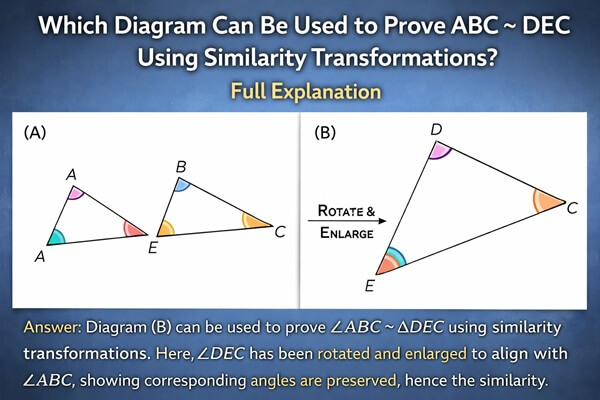
The diagram that can be used to prove triangle ABC is similar to triangle DEC using similarity transformations is the one that shows the two triangles sharing vertex C, with angle B congruent to angle E and the triangles positioned so that a dilation centered at point C, combined with a rotation if needed, maps one triangle onto the other.
In the most common version of this problem, the correct diagram shows triangles ABC and DEC connected at point C, where C is the vertex shared by both triangles. The angles at B and E are marked as congruent, and the vertical angles at C (angle ACB and angle DCE) are equal. These two pairs of congruent angles satisfy the Angle-Angle (AA) similarity criterion, which is sufficient to prove the triangles are similar.
If you are looking at a multiple-choice question with diagrams, choose the diagram where the two triangles meet at point C, corresponding angles are marked congruent, and the triangles appear to be scaled versions of each other rather than congruent or differently oriented. The rest of this article explains exactly why that diagram works and how to reason through it from first principles.
The Foundations: What Triangle Similarity Means
Before analyzing any specific diagram, it is worth being clear about what it actually means to say that two triangles are similar. Two triangles are similar when they have the same shape but not necessarily the same size. More precisely, all three pairs of corresponding angles are equal, and all three pairs of corresponding sides are proportional, meaning they share the same ratio.
The notation triangle ABC similar to triangle DEC, written as triangle ABC followed by the tilde symbol followed by triangle DEC, carries specific meaning beyond just saying the triangles are similar. The order of the letters tells you which vertices correspond. A corresponds to D, B corresponds to E, and C corresponds to C. That last pairing is significant: C corresponds to itself, which is the structural clue that tells you the two triangles share a common vertex in the correct diagram.
This vertex correspondence also tells you something about the transformation. If C is the shared vertex and C maps to itself, then any dilation that maps one triangle to the other must be centered at C. A dilation always maps its center to itself, so a dilation centered at C will keep C fixed while scaling all other points outward or inward. This is why the correct diagram places both triangles with a common point at C rather than showing them in completely separate positions.
What a Similarity Transformation Actually Is
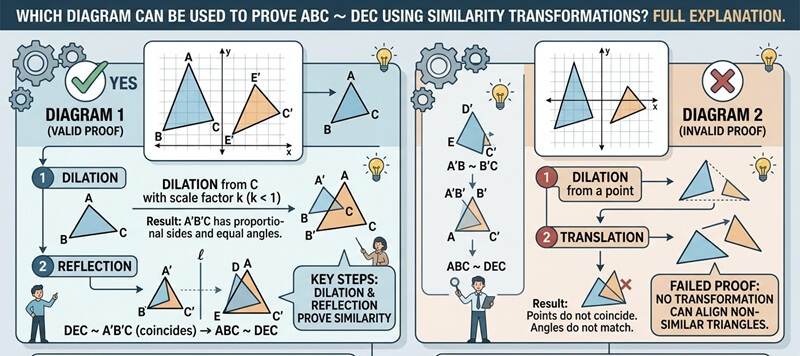
A similarity transformation is a combination of one or more of the following transformations: dilations, reflections, rotations, and translations. What makes it a similarity transformation specifically, rather than just any geometric transformation, is that it preserves the shape of a figure while potentially changing its size or orientation.
Of these four types, the dilation is the only one that changes size. A dilation with a scale factor greater than one enlarges a figure. A scale factor between zero and one shrinks it. A scale factor of negative one produces a figure that is reflected through the center of dilation. Crucially, all dilations preserve angle measures, which means a dilated triangle has exactly the same angles as the original.
Reflections, rotations, and translations are rigid motions: they preserve both shape and size. When combined with a dilation, they can change the position and orientation of the figure while the dilation handles the change in size. A similarity transformation that maps triangle ABC onto triangle DEC might consist of a dilation centered at C followed by a rotation, or a dilation followed by a reflection, depending on how the two triangles are oriented relative to each other.
The key insight for this problem is that any sequence of transformations that maps one triangle onto the other, while preserving angle measures and maintaining proportional sides, constitutes a valid similarity transformation. The diagram needs to show a configuration where such a sequence of transformations can be described and executed.
The diagram that works for proving triangle ABC similar to triangle DEC is the one where D lies on segment AC, E lies on segment BC, and segment DE is parallel to segment AB. This configuration, known in geometry as the side splitter configuration or as a triangle with a parallel line through it, is one of the most common setups for this specific type of proof.
The Shared Vertex and What It Reveals
When D is on AC and E is on BC, both triangles share vertex C. Triangle ABC has vertices A, B, and C. Triangle DEC has vertices D, E, and C. The vertex C is common to both. This is the geometric signature of a dilation centered at C: because C maps to itself under any dilation centered at C, both triangles naturally share that point.
From this configuration, the scale factor of the dilation is the ratio CD to CA, which equals CE to CB. Because DE is parallel to AB, this ratio is consistent across both sides that emanate from C, which confirms that a single dilation centered at C can map triangle DEC onto triangle ABC or vice versa.
The Angle Relationships That Make It Work
There are two pairs of congruent angles in this configuration, and together they satisfy the AA criterion completely. The first pair is angle C, which is shared. Both triangle ABC and triangle DEC include the same angle at vertex C, angle ACB in triangle ABC and angle DCE in triangle DEC. These are the same angle, not just equal angles, because both triangles occupy the same region at vertex C. Any angle is congruent to itself, which is called the reflexive property.
The second pair comes from the parallel lines. Because DE is parallel to AB, the line BC acts as a transversal cutting those parallel lines. The angles formed at E in triangle DEC and at B in triangle ABC are corresponding angles cut by a transversal through parallel lines. By the Corresponding Angles Postulate, these angles are congruent. So angle DEC in triangle DEC equals angle ABC in triangle ABC.
With two pairs of congruent angles established, the AA criterion confirms similarity. The third pair of angles is automatically equal because the angles in any triangle sum to 180 degrees. If two angles in triangle ABC match two angles in triangle DEC, the third must also match.
The Transformation Sequence That Maps One to the Other
Having established similarity through AA, you can also describe the actual transformation sequence. A dilation centered at C with scale factor CD divided by CA maps triangle ABC to triangle DEC by moving A to D and B to E while keeping C fixed. Because the triangles share the same orientation at vertex C in this configuration, no rotation is necessary after the dilation. The dilation alone maps triangle ABC onto triangle DEC.
This cleanness of transformation, a single dilation with a defined center and calculable scale factor, is part of why the shared vertex diagram is the standard and most elegant choice for this particular proof.
Why Other Types of Diagrams Do Not Work for This Proof
Understanding why the correct diagram works requires understanding what makes other configurations insufficient. This is especially useful when you are faced with a multiple-choice question and need to eliminate wrong answers confidently.
Diagrams Where the Angles Are Different
Any diagram that shows different angle measures in triangle ABC and triangle DEC immediately fails. If the angles do not match, the triangles are not similar by definition. This sounds obvious but it is worth stating explicitly: similarity begins and ends with angle congruence. A diagram that shows triangle ABC with, say, a 70-degree angle and 50-degree angle but shows triangle DEC with a 60-degree angle and 40-degree angle is not showing similar triangles regardless of how the triangles are positioned or what transformations are suggested.
Diagrams Where the Triangles Have Different Shapes
Some diagrams show two triangles labeled with the right letters but with visibly different proportions or shapes. If triangle ABC is clearly a right triangle and triangle DEC is an equilateral triangle, for example, they cannot be similar because their angle sets do not match. A correct diagram for this proof will always show two triangles that look proportionally identical, just at different scales.
Diagrams Where the Letter Correspondence Does Not Support the Transformation
The letter correspondence in triangle ABC similar to triangle DEC specifies that C corresponds to C. A diagram that shows C as a vertex of triangle ABC but places it in a position that has no geometric relationship to the C in triangle DEC fails to reflect the required vertex correspondence. Specifically, if the two triangles are shown in completely separate positions with no shared point and no indication of how one transforms into the other through a dilation centered at a definable point, the diagram cannot support a clean similarity transformation proof.
Diagrams Showing Reflection Without Dilation
A reflection alone produces a congruent figure, not a similar one, unless the two triangles happen to be the same size. If a diagram shows triangle DEC as a reflection of triangle ABC across some line, with both triangles appearing to be the same size, then the triangles would be congruent rather than merely similar. A proof of similarity requires that the transformation include a dilation with a scale factor other than one or negative one, unless the question specifically allows for the case where the similar triangles are also congruent.
The AA Criterion: The Most Important Tool for This Proof
The Angle-Angle criterion, universally abbreviated as AA in geometry, states that if two angles of one triangle are congruent to two corresponding angles of another triangle, then the two triangles are similar. It is the most commonly used and easiest to apply of the three triangle similarity criteria.
The reason only two angles are needed is that the angles of any triangle always sum to 180 degrees. If you know that two angles in triangle ABC equal two corresponding angles in triangle DEC, then the third pair of angles must also be equal because both thirds are determined by the same subtraction from 180. Establishing two angle pairs is therefore sufficient to guarantee all three.
In the context of the triangle ABC similar to triangle DEC problem, AA works through two specific angle pairs. The angle at C is shared, satisfying one pair instantly through the reflexive property. The second pair requires external information about the diagram: either a marking that shows angle B equals angle E directly, or geometric information like parallel lines that allows you to conclude the angles are equal through a theorem like the Corresponding Angles Postulate or the Alternate Interior Angles Theorem.
When you see a diagram for this problem and you are trying to determine whether it supports the proof, the first thing to look for is whether there is a way to establish two pairs of congruent corresponding angles. If there is, the diagram works. If there is not, even if the triangles look similar, the diagram does not provide sufficient evidence for the proof.
Also read: Gimkit Code: What It Is, How It Works, and How to Join Games Easily
How to Approach This Question on a Test or Assignment
When this question appears in a geometry course, whether as a multiple-choice problem or a written proof exercise, there is a systematic approach that makes finding the correct answer reliable rather than guesswork.
Step One: Read the Correspondence Carefully
Triangle ABC similar to triangle DEC means A corresponds to D, B corresponds to E, and C corresponds to C. Write this down explicitly. This tells you that the correct diagram will have the vertex labeled C appearing in the same structural position in both triangles. In most versions of this problem, C is the shared vertex where the two triangles meet.
Step Two: Identify the Shared or Related Elements
Look at each diagram option and ask: do these two triangles share any vertices, sides, or angles? In the correct diagram, they share vertex C. This shared vertex is the center of the dilation that maps one triangle to the other. If a diagram shows the triangles completely separate with no shared points, that is a signal to be cautious, as you will need to work harder to define the transformation.
Step Three: Look for Marked Congruent Angles
Most geometry diagrams use tick marks and arc marks to indicate congruent angles and sides. In the correct diagram for this problem, you will typically see arc marks at angle B in triangle ABC and angle E in triangle DEC indicating they are equal, and the angle at C is understood to be shared. If a diagram shows arc marks at angles that do not correspond correctly under the A-to-D, B-to-E, C-to-C mapping, it is the wrong diagram.
Step Four: Check Whether a Dilation Makes Sense
Ask yourself: is there a point and a scale factor that would map one triangle onto the other? In the correct diagram, the answer is yes: the center is C and the scale factor is the ratio of a side in triangle DEC to the corresponding side in triangle ABC. If the triangles are oriented so that no single dilation, possibly combined with a rotation or reflection, can align them, the diagram does not support a clean similarity transformation proof.
Step Five: Eliminate Diagrams That Show Impossibilities
Any diagram where the angle measures are labeled and do not match between corresponding vertices is immediately wrong. Any diagram where the triangles clearly have different shapes is wrong. Any diagram where the vertex labeled C in one triangle appears to correspond to a vertex not labeled C in the other triangle violates the stated similarity notation and is wrong.
All Similarity Criteria and How They Apply to This Proof
The table below summarises all similarity criteria relevant to proving triangle ABC similar to triangle DEC and indicates how each applies to the standard diagram for this problem.
| Criterion | What Must Be Shown | Minimum Evidence Required | Works for ABC ~ DEC? |
| AA (Angle-Angle) | Two pairs of corresponding angles are congruent | angle B = angle E AND angle BCA = angle ECD (or angle C shared) | Yes. Most common proof method |
| SAS (Side-Angle-Side) | Two pairs of sides proportional, included angle congruent | AB/DE = BC/EC AND included angle equal | Yes, if side ratios and angle shown |
| SSS (Side-Side-Side) | All three pairs of corresponding sides proportional | AB/DE = BC/EC = AC/DC | Yes, but requires all three ratios |
| Dilation only | One triangle is a scaled version of the other | Center of dilation and scale factor identified | Partial. Needs orientation match too |
| Dilation plus rotation | Scale and orientation both addressed | Center C, scale factor, rotation angle defined | Yes. Used when triangles share vertex C |
| Reflection plus dilation | Reflection aligns orientation, dilation scales size | Line of reflection and scale factor defined | Yes, when triangles are mirror-oriented |
A Worked Example: Using the Correct Diagram to Write the Proof
To make this concrete, here is a complete worked proof using the standard diagram where D lies on AC, E lies on BC, and DE is parallel to AB.
Given: Triangle ABC with point D on segment AC and point E on segment BC such that DE is parallel to AB. Prove: Triangle DEC is similar to triangle ABC.
The proof begins with the shared angle. Angle DCE is the same as angle ACB because both are the angle at vertex C in the same region of the diagram. By the reflexive property, angle ACB is congruent to angle DCE. That is the first pair of congruent angles.
For the second pair, because DE is parallel to AB, and BC is a transversal crossing both parallel lines, angle DEC and angle ABC are corresponding angles. By the Corresponding Angles Postulate, corresponding angles formed by a transversal cutting parallel lines are congruent. Therefore angle DEC is congruent to angle ABC.
With two pairs of corresponding angles established, angle ACB congruent to angle DCE and angle ABC congruent to angle DEC, the AA similarity criterion confirms that triangle ABC is similar to triangle DEC.
To express this as a similarity transformation: there exists a dilation centered at C with scale factor equal to CD divided by CA that maps triangle ABC to triangle DEC. Under this dilation, point A maps to point D because D is on ray CA at distance CD from C. Point B maps to point E for the same reason. Point C maps to itself because it is the center of dilation. The dilation therefore maps triangle ABC precisely onto triangle DEC, confirming the similarity through a geometric transformation.
Common Mistakes Students Make with This Type of Problem
Understanding where students most often go wrong with similarity transformation proofs helps you avoid the same errors when the question appears on a test.
The most frequent mistake is confusing similarity with congruence. Students sometimes identify a diagram where the two triangles are the same size and correctly oriented, which would actually make them congruent rather than similar. Congruence is a special case of similarity where the scale factor is exactly one, but a question asking you to prove similarity using transformations that include a dilation is implying the triangles are different sizes. Look for a diagram where the triangles are clearly at different scales.
The second most common mistake is misreading the vertex correspondence. Triangle ABC similar to triangle DEC does not mean A corresponds to A, B to B, and C to C in some generic way. It means A corresponds to D, B corresponds to E, and C corresponds to C. Students who misread this and look for a diagram where the A positions match up rather than the A-to-D correspondence will choose the wrong answer.
A third common error is accepting a diagram that shows congruent angles without verifying they are the correct corresponding angles. A diagram might show angle A in triangle ABC equal to angle D in triangle DEC, which looks plausible, but if the triangles are positioned such that A and D are not actually corresponding vertices under the stated similarity, the diagram is misleading rather than helpful.
Finally, students sometimes try to prove similarity using SSS when AA is available. While SSS works perfectly well, it requires calculating or being given all three side ratios, which is more work than necessary when two congruent angle pairs are already visible in the diagram. If you can see two congruent angle pairs, use AA. It is faster, more direct, and less prone to arithmetic errors.
Frequently Asked Questions
Q1. Which diagram can be used to prove triangle ABC is similar to triangle DEC using similarity transformations?
The correct diagram is the one showing triangles ABC and DEC sharing vertex C, where point D lies on segment AC and point E lies on segment BC, with DE parallel to AB. In this configuration, angle ACB equals angle DCE because they are the same angle, and angle ABC equals angle DEC because they are corresponding angles formed by the parallel lines. These two pairs of congruent angles satisfy the AA criterion, and the triangles can be mapped onto each other through a dilation centered at C.
Q2. Why does vertex C appear in both triangle names for this similarity statement?
In the similarity notation triangle ABC similar to triangle DEC, the letter order tells you which vertices correspond. A corresponds to D, B corresponds to E, and C corresponds to C. The fact that C appears in the same position in both triangle names means C is the vertex that maps to itself under the similarity transformation. This is the geometric signature of a dilation centered at C: the center of dilation always maps to itself. The correct diagram therefore shows both triangles sharing the same vertex C.
Q3. What is the AA criterion and why is it enough to prove triangle similarity?
The Angle-Angle criterion states that if two angles of one triangle are congruent to two corresponding angles of another triangle, the triangles are similar. Two pairs of congruent angles are sufficient because the three angles of any triangle must sum to 180 degrees. If two angle pairs match, the third pair automatically matches as well since both third angles equal 180 degrees minus the same two established angle values.
Q4. What role does the dilation play in the similarity transformation proof?
The dilation is the transformation that maps one triangle onto the other at the correct scale. In the shared vertex diagram, the dilation is centered at C with a scale factor equal to CD divided by CA. This dilation moves point A to point D, moves point B to point E, and keeps C fixed. Because dilations preserve angle measures while changing distances by a consistent ratio, the dilation produces a triangle with identical angles and proportional sides, which is the definition of a similar triangle.
Q5. Do I need a rotation or reflection in addition to the dilation for this proof?
In the standard configuration where D is on AC and E is on BC with DE parallel to AB, no rotation or reflection is needed. The dilation centered at C alone maps triangle ABC to triangle DEC because the triangles are already aligned in the same orientation at vertex C. In other configurations where the triangles have different orientations, a rotation or reflection might be needed before or after the dilation to complete the mapping.
Q6. What does it mean when a diagram shows DE parallel to AB?
When DE is parallel to AB in this configuration, it establishes a specific angle relationship between the two triangles. Any transversal crossing both parallel lines creates pairs of corresponding angles that are congruent. Line BC acts as a transversal cutting DE and AB, so the angles at E and B are corresponding angles and therefore congruent. This gives the second pair of congruent angles needed for the AA criterion after the shared angle at C provides the first pair.
Q7. How is similarity different from congruence in the context of transformations?
Congruent figures are identical in both shape and size. Similar figures are identical in shape but can differ in size. In terms of transformations, congruence is produced by rigid motions only: reflections, rotations, and translations, which preserve both shape and size. Similarity requires including a dilation, which changes size while preserving shape. A similarity transformation that includes a dilation with a scale factor other than one produces similar but not congruent figures.
Q8. Why do some diagrams fail to prove triangle ABC similar to triangle DEC?
Diagrams fail for several reasons. A diagram showing different angle measures at corresponding vertices proves the triangles are not similar. A diagram where the vertex labeled C does not share the same structural role in both triangles does not support the required vertex correspondence. A diagram showing the triangles completely separate with no clear transformation pathway makes it difficult to define the similarity transformation. A diagram where the triangles are the same size suggests congruence rather than similarity.
Q9. Can the SAS or SSS criterion also be used to prove this similarity?
Yes, both SAS and SSS similarity criteria can in principle be used to prove triangle ABC similar to triangle DEC, but they require more information than AA. SAS requires showing that two pairs of corresponding sides are proportional and the included angle between them is congruent. SSS requires showing that all three pairs of corresponding sides are proportional. In the standard diagram for this problem, AA is the simplest and most direct approach because the angle relationships are immediately visible without needing side length calculations.
Q10. How do I identify the correct diagram in a multiple-choice question?
Look for the diagram where both triangles share vertex C, the triangles appear to be at different scales but the same shape, and there are angle marks indicating that two pairs of corresponding angles are congruent. Eliminate diagrams showing different angle measures, different shapes, same-sized triangles, or vertex positions that contradict the A-to-D, B-to-E, C-to-C correspondence stated in the similarity notation. The correct diagram will clearly support a dilation centered at C as the primary similarity transformation.
Conclusion
The question of which diagram can be used to prove triangle ABC similar to triangle DEC using similarity transformations has a clear and principled answer. The correct diagram is the one where the two triangles share vertex C, with the two triangles positioned so that a dilation centered at C maps one onto the other.
The proof works because the shared vertex at C immediately gives one pair of congruent angles through the reflexive property, and the geometric configuration, typically DE parallel to AB, provides the second pair through the Corresponding Angles Postulate. Two congruent angle pairs satisfies the AA criterion and confirms similarity. The dilation centered at C with scale factor CD over CA is the transformation that executes the mapping geometrically.
What makes this problem easier than it initially appears is that the vertex correspondence encoded in the similarity notation, specifically the fact that C maps to C, tells you exactly what to look for in the diagram before you analyze a single angle or measurement. Find the diagram where both triangles share vertex C, and you have found the diagram that supports the proof.