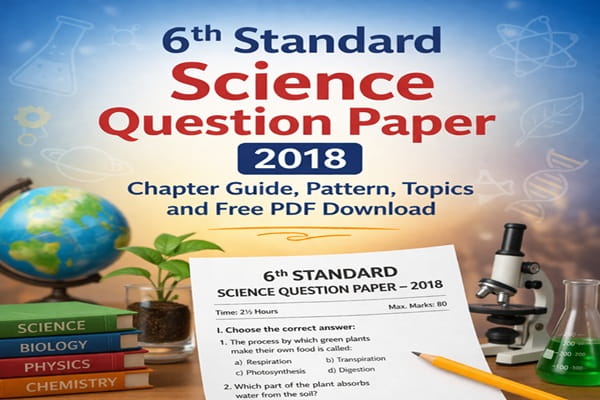
The first time a student sits in a science exam that tests more than just definitions, something changes. Class 6 is where that shift happens. Suddenly the paper asks you to explain why things happen, draw diagrams, relate everyday observations to scientific principles, and answer in a structured format.
The 6th standard science question paper from 2018 is a direct record of that expectation. It shows which topics were considered important enough to examine, how much weight each type of question carried, and what kind of thinking was expected from a twelve-year-old student studying science.
This guide goes through everything: the paper pattern, board-by-board differences, a full chapter-by-chapter breakdown, where to download PDFs, how to use these papers for maximum exam benefit, and the mistakes students consistently make. It covers CBSE, Tamil Nadu Samacheer Kalvi, Karnataka, Kerala, and KVS schools.
Contents
- 1 The 6th Standard Science Exam Pattern in 2018
- 2 Chapter-by-Chapter Breakdown of the 2018 Science Paper
- 3 Biology Topics That Appeared Most in the 2018 Paper
- 4 Chemistry Topics That Appeared Most in the 2018 Paper
- 5 How the 2018 Science Paper Differed Across Boards
- 6 Where to Download the 6th Standard Science Question Paper 2018
- 7 How to Use the 2018 Science Paper Effectively
- 8 Mistakes Students Make in 6th Standard Science Exams
- 9 High-Value Topics to Prioritise from the 2018 Paper
- 10 Pre-Exam Revision Checklist for 6th Standard Science
- 11 Frequently Asked Questions
- 11.1 1. Is the 6th standard science question paper 2018 still relevant for preparing today?
- 11.2 2. What are the most important chapters in the 6th standard science paper 2018?
- 11.3 3. How many sections were in the 6th standard science paper 2018?
- 11.4 4. What type of questions appeared in the biology section of the 2018 paper?
- 11.5 5. Were diagrams compulsory in the 2018 science paper?
- 11.6 6. Where can I find the Tamil Nadu 6th standard science question paper 2018?
- 11.7 7. What is the total marks for the 6th standard science exam in 2018?
- 11.8 8. How is the 2018 paper different from current CBSE Class 6 Science papers?
- 11.9 9. What were the most common MCQ topics in the 2018 Class 6 Science paper?
- 11.10 10. Is the Homi Bhabha exam question paper from 2018 useful for school exam preparation?
- 12 Conclusion
The 6th Standard Science Exam Pattern in 2018
Most boards and schools in India followed a four-section structure for the Class 6 Science paper in 2018. The sections tested progressively deeper knowledge, starting from memory-based questions and moving toward application and explanation.
| Section | Question Type | No. of Questions | Marks per Q | Total Marks |
| Section A | Multiple Choice Questions (MCQ) | 8 to 15 | 1 mark | 8 to 15 |
| Section B | Very Short Answer (VSA) | 6 to 8 | 2 marks | 12 to 16 |
| Section C | Short Answer (SA) | 7 to 9 | 3 marks | 21 to 27 |
| Section D | Long Answer (LA) | 3 to 5 | 5 marks | 15 to 25 |
CBSE-affiliated schools in 2018 typically ran the Class 6 Science paper for 2.5 to 3 hours. Total marks were 80 for theory, with 20 marks reserved for internal assessment covering practical work, projects, and notebooks. Some schools used 5 sections with an added case-based or diagram question block.
Tamil Nadu schools using the Samacheer Kalvi curriculum followed a term-wise system. The 2018 first-term exam question paper covered only the Term 1 portion of the syllabus. The paper pattern here used choose the correct answer, fill in the blanks, match the following, and answer in brief formats.
KVS (Kendriya Vidyalaya) Science Paper Pattern 2018
KVS schools maintained three separate Periodic Tests (PT-I, PT-II) and one Terminal Exam in 2018-19. All three used different question sets from the same NCERT syllabus. The KV Gopalganj library blog archive includes actual PT-I, PT-II, and Term-II papers for Class VI Science from the 2018-19 session across KV schools.
Chapter-by-Chapter Breakdown of the 2018 Science Paper
The NCERT Class 6 Science textbook was the primary content source for CBSE and most affiliated schools in 2018. The book has 16 chapters covering Physics, Chemistry, and Biology. Here is how each chapter mapped to the question paper in terms of importance and question type.
| # | Chapter Name | Branch | Key Concepts Tested | Typical Marks |
| 1 | Food: Where Does It Come From? | Biology | Sources of food, plants and animals as food sources | 2 to 3 marks |
| 2 | Components of Food | Biology | Nutrients, deficiency diseases, balanced diet | 3 to 5 marks |
| 3 | Fibre to Fabric | Chemistry | Plant fibres, animal fibres, spinning, weaving | 2 to 3 marks |
| 4 | Sorting Materials into Groups | Chemistry | Properties of materials, solubility, transparency | 3 to 5 marks |
| 5 | Separation of Substances | Chemistry | Methods: filtration, evaporation, sieving, sedimentation | 4 to 5 marks |
| 6 | Changes Around Us | Chemistry | Reversible vs irreversible changes, physical and chemical | 3 to 5 marks |
| 7 | Getting to Know Plants | Biology | Root, stem, leaf structure, flower parts | 3 to 5 marks |
| 8 | Body Movements | Biology | Types of joints, skeleton, movement in animals | 3 to 5 marks |
| 9 | The Living Organisms and Their Surroundings | Biology | Habitat, adaptation, biotic and abiotic factors | 4 to 5 marks |
| 10 | Motion and Measurement of Distances | Physics | Units of measurement, types of motion | 2 to 4 marks |
| 11 | Light, Shadows and Reflections | Physics | Transparent/opaque/translucent, shadow formation | 3 to 5 marks |
| 12 | Electricity and Circuits | Physics | Open/closed circuit, conductors, insulators, cell | 4 to 5 marks |
| 13 | Fun with Magnets | Physics | Magnetic poles, attraction/repulsion, compass | 2 to 3 marks |
| 14 | Water | Chemistry | Water cycle, drought, water conservation | 3 to 5 marks |
| 15 | Air Around Us | Biology | Composition of air, role of atmosphere, wind | 2 to 3 marks |
| 16 | Garbage In, Garbage Out | Biology | Waste management, composting, recycling | 2 to 3 marks |
Not all chapters carried equal weight in the 2018 paper. Based on patterns across CBSE school papers from that year, the five highest-scoring chapters were Separation of Substances, Electricity and Circuits, The Living Organisms and Their Surroundings, Components of Food, and Light Shadows and Reflections. These five alone accounted for a significant portion of the theory marks.
Biology Topics That Appeared Most in the 2018 Paper
Biology questions in the 6th standard 2018 paper tested both factual knowledge and understanding of relationships. Students who could explain why something happens, not just what happens, scored consistently better on the 3-mark and 5-mark questions.
Food and Nutrition Questions
This was one of the most predictable areas in the 2018 paper. Questions consistently followed a pattern:
- Name three nutrients found in food and their functions.
- What is a balanced diet? Name two deficiency diseases caused by lack of vitamins.
- Give examples of food items obtained from plants and from animals.
- What is the role of roughage in our diet?
Deficiency diseases were a popular 3-mark and 5-mark topic. Students were expected to know not just the disease name but also which nutrient was lacking and what symptoms appeared.
Plants and Body Questions
The chapter on Getting to Know Plants was heavily diagram-dependent. Questions asked students to label parts of a flower, draw the cross-section of a leaf, or identify root types. The Body Movements chapter asked students to name types of joints with examples from the human body.
Common question types that appeared in 2018:
- Draw a well-labelled diagram of a flower.
- Name the type of joint found at the knee, shoulder, and skull.
- What are the functions of the root in a plant?
- How does a fish move differently from a snail?
Habitat and Adaptations
This chapter consistently produced 5-mark long answer questions in the 2018 paper. Students were asked to describe how a specific animal or plant is adapted to survive in its habitat. Desert plants like cacti and animals like camels were standard examples. Aquatic and polar adaptations also appeared regularly.
Chemistry Topics That Appeared Most in the 2018 Paper
Class 6 Chemistry in 2018 was built around observation, properties of materials, and changes. Questions here rewarded students who could apply general rules to specific situations rather than just recite definitions.
Separation of Substances
This was consistently the highest-marks Chemistry chapter in 2018 papers across schools. Students needed to know at least six methods of separation and when each method is used:
- Sieving: separating materials of different sizes, such as flour from bran.
- Filtration: separating an insoluble solid from a liquid, such as chalk from water.
- Evaporation: recovering a dissolved solid from a solution, such as salt from salt water.
- Sedimentation and Decantation: settling of heavier particles and pouring off liquid.
- Magnetic separation: separating iron filings from sand using a magnet.
- Distillation: separating two miscible liquids with different boiling points.
The most common error in 2018 papers was students giving a method without explaining why that method is suitable for the given mixture. Marks were specifically deducted for this.
Changes Around Us
This chapter tested whether students could correctly classify changes as reversible or irreversible, and physical or chemical. Questions asked for two examples of each type. The most common 5-mark question was: explain five differences between physical and chemical changes with examples.
| PHYSICAL CHANGES (Reversible)
Ice melting to water Stretching a rubber band Folding paper Dissolving sugar in water Bending a wire |
CHEMICAL CHANGES (Irreversible)
Burning of wood Rusting of iron Curdling of milk Cooking of food Ripening of fruit |
Sorting Materials and Their Properties
This chapter had mainly 1-mark MCQ and 2-mark VSA questions. Students were asked to classify materials as transparent, translucent, or opaque, identify which materials conduct electricity, and state whether a given substance is soluble or insoluble in water.
Physics Topics That Appeared Most in the 2018 Paper
The Physics portion of the 2018 Class 6 Science paper covered four chapters: Motion and Measurement, Light Shadows and Reflections, Electricity and Circuits, and Fun with Magnets. Electricity and Circuits was consistently the most heavily tested Physics chapter.
Electricity and Circuits
This chapter produced the most long-answer and diagram questions in 2018. Students needed to understand open and closed circuits, draw circuit diagrams using standard symbols, and identify conductors and insulators.
Questions that appeared frequently in 2018:
- Draw a simple electric circuit using a cell, bulb, switch, and connecting wires. Show the direction of current flow.
- What is the difference between an open circuit and a closed circuit? Give one example of each.
- Name five conductors and five insulators you can find at home.
- Why does an electric bulb glow when connected in a circuit?
Students who lost marks here were mostly those who drew circuit diagrams without using the correct symbols for a cell and a bulb. Two marks were typically awarded for the diagram alone.
Light, Shadows and Reflections
Shadow formation questions used a specific format. Students were given a setup and asked to predict the shadow size, shape, or location. Questions on transparent, translucent, and opaque objects were almost guaranteed as 1-mark or 2-mark questions.
A frequently missed point in 2018: students confused luminous and non-luminous objects. The sun, a candle, and an electric bulb are luminous. The moon, a table, and a mirror are non-luminous. This distinction appeared as a direct definition question in multiple 2018 papers.
Motion and Measurement
This chapter was more straightforward than others in the Physics section. Questions focused on the SI unit of length (metre), types of motion (linear, circular, oscillatory, random), and the need for standard units. Students were asked to measure the length of a curved line using a thread, which is a practical-application question.
Fun with Magnets
This chapter had lighter marks in the 2018 paper compared to others. Standard questions included: what happens when the north poles of two magnets are brought near each other, how a compass needle points, and which materials are attracted to a magnet.
Also Read : Kerala Syllabus Question Papers Class 6 – Free PDF Download Guide (2025-2026)
How the 2018 Science Paper Differed Across Boards
| Board | Exam Type in 2018 | Total Marks | Textbook Used | Notable Feature |
| CBSE | Annual / SA2 | 80 theory + 20 internal | NCERT Class 6 Science | Four-section paper; diagram and MCQ heavy |
| TN Samacheer | Three-Term (Term 1 in 2018) | Varies by district | Samacheer Kalvi Class 6 Science | Term-wise papers; choose correct, fill blanks |
| Karnataka Board | Post-test 2018-19 | Varies (2-page paper) | State-prescribed textbook | Pre and post-test format; Kannada version available |
| KVS Schools | PT-I, PT-II, Term II | 20 (PT) + 80 (Term) | NCERT Class 6 Science | Three separate assessments per year |
| Kerala Board | Half-yearly exam | School-specified | SCERT Kerala textbook | Both Malayalam and English medium papers |
| Homi Bhabha | Competitive exam 2018 | 28 MCQ questions | General Science Class 6 | Physics, Chemistry, Biology MCQs only |
Where to Download the 6th Standard Science Question Paper 2018
Multiple platforms host the 2018 Class 6 Science papers across boards. Here is a curated list organized by board so you can find exactly what you need without spending time on irrelevant search results.
CBSE Class 6 Science Papers 2018
- com: Hosts multiple CBSE Class 6 Science question paper sets including the half-yearly exam 2018 and annual exam papers from VBPS and Suncity School. Includes solutions.
- com: Direct access to CBSE Class 6 Science sample paper from the half-yearly exam 2018 and annual exam from Suncity School. Requires points to download some papers.
- com: Previous year CBSE Class 6 Science papers from 2005 to 2022 in PDF format. The 2018 paper includes a standard four-section layout with solutions.
- com: Subject-wise Class 6 Science previous year question paper download links. Free PDF access.
- com: Free CBSE Class 6 Science sample papers aligned with the 2018 pattern. Multiple sets available.
- com: Sample paper sets for Class 6 Science with step-by-step solutions including mock papers matching 2018 exam format.
Tamil Nadu Samacheer Kalvi 6th Standard Science Papers 2018
- net: One of the most comprehensive sources for Tamil Nadu school papers. Hosts the 6th Standard All Subjects Original Question Paper 2018 by Mr. S. Ravikumar (Tamil Medium) and the 6th Science Answer Key with Question Paper for First Term Exam 2018 (Chennai District, English Medium) by Mr. Anto.
- Also available: 6th Science Answer Key with Question Paper for First Term Exam 2018 from Tiruvannamalai District by Mrs. V. Sujitha.
Karnataka Board 6th Standard Science Papers 2018
- inya.in (InyaTrust): Hosts the 6th std science post-test question paper Kannada version 2018-19 prepared by Anju, Sakaleshpura. 204 KB PDF, 2 pages, scanned copy.
- Also available on InyaTrust: Pre-test version of the same paper for self-assessment before and after the unit.
KVS Schools Papers 2018
- blogspot.com: KV Gopalganj library blog hosts Class VI Science PT-I, PT-II, and Term-II papers from the 2018-19 session conducted by KV Sitapur and KV Manauri.
Homi Bhabha Exam 2018
- com: The Homi Bhabha Stage 1 2018 Std 6th Question Paper by Rao IIT Academy is available as a 28-question MCQ paper covering Physics, Chemistry, and Biology. Useful for students preparing for competitive science assessments.
How to Use the 2018 Science Paper Effectively
Most students make the same mistake with previous year papers. They solve the questions, check their answers, and put the paper away. That approach recovers about 20 percent of the value the paper can provide. Here is a method that gets you the full benefit.
Stage 1: Solve the Paper as a Diagnostic Tool
Before revising any chapter, solve the 2018 paper cold under timed conditions. This is not a test of your current preparation. It is a map of your gaps. Mark every question you could not answer confidently, even if your guess turned out to be correct.
Stage 2: Identify Your Three Weakest Chapters
After scoring, list the chapters where you lost the most marks. Most students find the same pattern: they lose marks in Separation of Substances (because they cannot explain when each method is used), Living Organisms and Habitats (because they cannot describe adaptations with enough detail), and Electricity and Circuits (because their diagrams are incorrect or incomplete).
Stage 3: Revise with the Paper in Mind
Go back to your NCERT textbook and read only the chapters where you lost marks. While reading, write down every fact that could become a one-mark or two-mark question. Then write down every process that could become a three-mark or five-mark question.
Stage 4: Attempt Similar Questions from the Paper
Go back to the 2018 paper. This time, attempt only the questions from the chapters you revised. Check not just whether your answer is correct, but whether it matches the expected format. A 3-mark question expects three distinct points, not a paragraph that mentions three things in passing.
Stage 5: Compare Answers with the Marking Scheme
The marking scheme tells you something the question paper does not: exactly what the examiner wanted to read. If you wrote a different answer that is also correct, check whether the marking scheme would give you marks for it. This trains you to answer in exam language, not just in correct language.
Mistakes Students Make in 6th Standard Science Exams
These errors appear consistently across student answer sheets in Class 6 Science. Knowing them in advance lets you avoid them.
Diagram Errors
- Drawing diagrams without labels: An unlabelled diagram gets zero marks for the labelling part, even if the drawing is accurate.
- Missing arrows in circuit diagrams: Arrows showing direction of current flow are part of the standard answer.
- Drawing a shadow incorrectly: Students often draw the shadow on the wrong side of the object. The shadow always forms on the side opposite to the light source.
- Not naming diagram parts: Naming should use the exact terms from the textbook, not casual descriptions.
Definition and Classification Errors
- Confusing physical and chemical changes: Rusting is a chemical change but students often mark it as physical. The test is simple: if a new substance forms, it is a chemical change.
- Mixing up transparent, translucent, and opaque: Clear glass is transparent. Frosted glass is translucent. A brick wall is opaque. Using the wrong term loses the full mark.
- Wrong units for measurement: Writing centimetre when the answer requires metre, or missing the unit entirely.
- Incomplete answers to why questions: Writing ‘because it is an insulator’ without explaining what an insulator is loses half the marks.
Writing Technique Errors
- Not numbering points in multi-point answers: A 3-mark question expects three numbered points. A paragraph answer is harder to mark and often receives fewer marks.
- Writing too much for MCQ explanations: Multiple choice answers do not require justification unless the question asks for it.
- Missing definitions before explanations: For 5-mark questions, always start with a one-line definition of the key term before expanding.
High-Value Topics to Prioritise from the 2018 Paper
Based on analysis of 2018 question papers across CBSE, Samacheer, and KVS schools, the following topics gave the most marks and appeared most frequently. Mastering these five areas covers a large portion of the exam.
1. Separation Methods: Six Methods with Examples
This is the most reliable marks source in the Chemistry section. Know all six methods, the property each exploits, an everyday example, and a diagram for filtration and evaporation. This alone can secure 8 to 10 marks across multiple question types.
2. Adaptations in Habitats: Three Environment Types
Prepare detailed adaptations for desert, aquatic, and polar environments. For each, know at least two plant examples and two animal examples with specific structural and behavioral adaptations. This chapter typically produces the 5-mark long answer question.
3. Electric Circuits: Drawing and Component Knowledge
Practice drawing a complete circuit diagram from memory at least five times. Know the symbols for a cell, bulb, switch, connecting wire, and battery. Know which common materials are conductors and which are insulators. This chapter is worth 5 to 8 marks in most papers.
4. Changes Around Us: Four-Column Table
Create a table with four columns: Physical Change, Chemical Change, Reversible Change, Irreversible Change. Write ten examples in each. Some changes appear in multiple columns, which is a common question trap. For example, burning is a chemical change AND an irreversible change.
5. Deficiency Diseases: Nutrient, Disease, and Symptom
Prepare a three-column table: Nutrient, Deficiency Disease, Key Symptom. Vitamin C and scurvy, Vitamin D and rickets, Iron and anaemia, Vitamin A and night blindness, Calcium and weak bones. This table format is itself a common question format in the 2018 paper.
Pre-Exam Revision Checklist for 6th Standard Science
Biology Checklist
- Can name all nutrients and their functions from Chapter 2
- Know three deficiency diseases with nutrient and symptom
- Can label a flower diagram: sepals, petals, stamen, pistil
- Know types of joints: ball and socket, hinge, pivot, fixed
- Can explain desert, aquatic, and polar adaptations with examples
- Understand biotic and abiotic components of a habitat
Chemistry Checklist
- Know all six separation methods with examples and when to use each
- Can classify any given change as physical or chemical with reason
- Know properties of materials: solubility, transparency, conductivity
- Understand the water cycle: evaporation, condensation, precipitation
Physics Checklist
- Can draw a complete electric circuit with correct symbols
- Know 5 conductors and 5 insulators with examples
- Understand transparent, translucent, and opaque with examples
- Know types of motion: linear, circular, oscillatory, random
- Understand magnetic poles and attraction/repulsion rules
Frequently Asked Questions
1. Is the 6th standard science question paper 2018 still relevant for preparing today?
Yes. The NCERT Class 6 Science syllabus has not changed significantly since 2018. The same 16 chapters are still being examined. The question types, marks distribution, and chapter weightage patterns from 2018 remain a reliable guide for current exam preparation. For Tamil Nadu schools, the 2018 Samacheer papers are relevant for the same reason as the new 2018-19 curriculum was introduced for Class 6 that year.
2. What are the most important chapters in the 6th standard science paper 2018?
The highest-value chapters in the 2018 CBSE and KVS papers were Separation of Substances, The Living Organisms and Their Surroundings, Electricity and Circuits, Components of Food, and Light Shadows and Reflections. These five chapters consistently appeared in both short answer and long answer sections. Tamil Nadu Samacheer papers had similar emphasis with additional focus on the new chapters introduced in 2018-19.
3. How many sections were in the 6th standard science paper 2018?
CBSE and KVS schools used four sections in 2018: Section A for MCQs carrying 1 mark each, Section B for very short answers of 2 marks, Section C for short answers of 3 marks, and Section D for long answers of 5 marks. Some schools added a fifth section for diagram-based or source-based questions.
4. What type of questions appeared in the biology section of the 2018 paper?
Biology questions in the 2018 paper included: name the nutrients and their deficiency diseases, label a diagram of a flower or leaf, explain adaptations of animals in specific habitats, describe types of joints in the human body, and differentiate between biotic and abiotic components. Long answer questions often asked students to write a paragraph on habitat adaptations.
5. Were diagrams compulsory in the 2018 science paper?
Diagram-based questions were a standard part of the 2018 paper, especially in Physics and Biology. Circuit diagrams for the Electricity and Circuits chapter were almost always required. Flower diagrams and leaf cross-sections appeared in the Biology section. Marks were specifically allocated for correct labelling, not just accurate drawing.
6. Where can I find the Tamil Nadu 6th standard science question paper 2018?
The Tamil Nadu Samacheer Kalvi 6th standard science question paper for the first term exam 2018 is available on padasalai.net. The site hosts the original question paper for all subjects from 2018 prepared by Mr. S. Ravikumar in Tamil Medium and the science-specific answer key paper for Chennai District in English Medium prepared by Mr. Anto.
7. What is the total marks for the 6th standard science exam in 2018?
For CBSE-affiliated schools, the total marks for Class 6 Science were 100: 80 for the written theory exam and 20 for internal assessment. The written paper was 2.5 to 3 hours long. Karnataka and Kerala school papers varied by school. Tamil Nadu’s term exams carried school-specified marks based on the district question paper format.
8. How is the 2018 paper different from current CBSE Class 6 Science papers?
The CBSE Class 6 Science paper format has evolved slightly since 2018. Current papers include more competency-based and case-based questions. The 2018 paper was more heavily weighted toward direct recall and structured explanation. However, the chapter content remains the same. Students should use 2018 papers for content familiarity and combine them with more recent sample papers for current format practice.
9. What were the most common MCQ topics in the 2018 Class 6 Science paper?
MCQ questions in the 2018 paper most commonly came from: properties of materials (soluble or insoluble, transparent or opaque), types of motion, components of food and nutrients, body joints and their types, and magnets and magnetic materials. These topics lend themselves naturally to single-correct-answer questions and were heavily represented in Section A.
10. Is the Homi Bhabha exam question paper from 2018 useful for school exam preparation?
The Homi Bhabha Stage 1 2018 paper for 6th standard is an MCQ-only paper with 28 questions covering all three science branches. It tests conceptual understanding more deeply than most school annual papers. Solving it is helpful for students who want to go beyond textbook definitions and understand how concepts apply to real situations. It is not a substitute for school paper practice but a useful supplement.
Conclusion
The 6th standard science question paper from 2018 covers exactly the kind of scientific thinking that makes a student genuinely good at the subject, not just exam-ready. Food and nutrition, material properties, separation methods, habitats and adaptations, electricity, and light are not isolated chapters. They connect to how the world actually works.
Use this guide to understand the paper pattern, identify which chapters deserve the most preparation time, learn what types of questions each chapter produces, and avoid the specific mistakes that cost students marks every year.
Solve the 2018 paper. Score it honestly. Work on your weak chapters using the NCERT textbook. Come back and solve it again. This single practice loop, done three times across different previous year papers, builds the kind of familiarity that removes exam-day uncertainty.